
If you’ve ever wondered why time feels faster as you get older, you’re not alone.
How is it already November?
Didn’t the year just start?
Remember when you were younger and summer vacation seemed to last forever? A single school year felt like an enormous chapter of your life.
Now, entire months seem to disappear.
You finish one busy week, turn around, and somehow it’s the end of another month. Birthdays arrive faster. Holidays seem closer together. And sometimes you wonder how five years went by so quickly.
Psychologists have studied this experience for decades. And one of the most interesting explanations involves something we don’t usually associate with time:
Memory.
Your brain doesn’t experience the past by replaying every minute you’ve lived. It reconstructs periods of your life from experiences you remember.
That distinction may help explain why some years feel rich and expansive, while others seem to vanish.
What Science Says About Why Time Feels Faster as You Get Older
Researchers Marc Wittmann and Sandra Lehnhoff investigated how people experience the passage of time.
Their study included 499 participants between the ages of 14 and 94.
The researchers found evidence supporting the familiar perception that time seems to accelerate with age.
But the relationship wasn’t especially strong. Age explained only a relatively small portion of the differences in people’s time judgments.
You can read their research on age and the perception of time through the National Library of Medicine.
This is important because it suggests that growing older isn’t the whole explanation.
Two people of the same age may experience the passage of time very differently.
Their routines, memories, emotions, and ways of looking back on life may all matter.
Understanding why time feels faster as you get older requires looking beyond chronological age and considering how the brain experiences and remembers events.
And there is another important distinction.
Your Brain Experiences Time in Two Different Ways
Think about the last time you waited in a doctor’s office.
You kept checking the clock.
Ten minutes felt like twenty.
Now think about a wonderful vacation.
You were exploring, talking, eating, laughing, or simply enjoying yourself.
The afternoon seemed to disappear.
But months later, that vacation might feel surprisingly substantial in your memory.
You can remember the places, conversations, restaurants, and unexpected moments.
Meanwhile, an ordinary workweek from the same month may barely stand out.
These examples illustrate two different ways of judging time.
Prospective time perception involves how long something feels while you’re experiencing it.
Retrospective time perception involves how long an experience seems when you look back on it.
They aren’t necessarily the same.
An enjoyable afternoon may pass quickly while it’s happening but leave you with many memorable experiences.
A monotonous afternoon might feel slow while you’re enduring it but leave very little that stands out afterward.
This distinction is important to understanding why time feels faster as you get older.
Sometimes the question isn’t how quickly the hours passed.
It’s how much of that period remains distinguishable in memory.
Why Familiar Routines Can Make the Months Blur Together
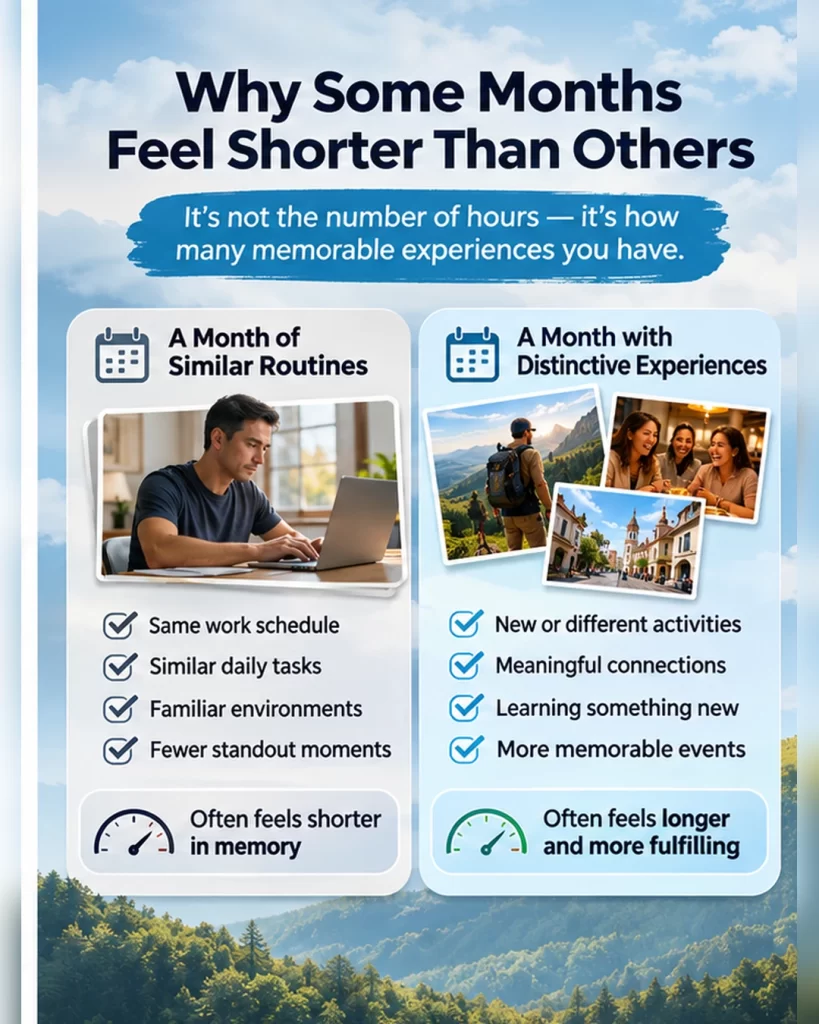
Imagine two different months.
During the first month, you follow almost exactly the same routine.
You wake up, work, run errands, eat dinner, check your phone, and go to sleep.
Most days look similar.
During the second month, you visit somewhere new, reconnect with an old friend, learn something unfamiliar, and have several memorable conversations.
Both months contain approximately the same number of hours.
But when you look back, they may feel very different.
[INSERT BLOG INFOGRAPHIC HERE: memory-markers-time-perception.webp]
One possible explanation for why time feels faster as you get older is that repeated experiences can leave fewer distinctive memory markers.
When your days resemble one another, it can become harder to separate one Tuesday from the next.
You know you were busy.
You know you accomplished things.
But the individual days become difficult to distinguish.
Memory researchers have examined how the structure of remembered events influences our judgments of duration.
A 2026 study of retrospective time judgments found that remembering the number of subevents in a viewed experience helped predict how long participants judged the experience to have lasted.
That doesn’t prove that adding activities to your calendar will make your year feel longer.
But it suggests that how we organize and remember experiences can influence how we judge their duration.
And that leads to an interesting possibility.
Maybe part of the reason some months disappear so quickly is that they leave behind fewer distinct landmarks in memory.
How Memory Shapes Why Time Feels Faster as You Get Older
Think about a trip you took ten years ago.
Perhaps you remember the hotel, an unexpected conversation, an unfamiliar meal, or a beautiful view.
Now think about an ordinary Wednesday from six months ago.
You probably worked, ate, and went about your responsibilities.
But can you reconstruct that particular Wednesday?
Probably not.
Our memories do not preserve every experience equally.
As we discussed in why you remember the big picture but forget the details, your brain often retains the broader meaning of experiences without preserving every individual moment.
That doesn’t mean the ordinary days were wasted.
They may have been productive, peaceful, or deeply satisfying.
But when you look back, your memory has relatively few distinctive details to separate them.
A special occasion, on the other hand, may provide several recognizable points of reference.
You remember what happened before it.
You remember the event itself.
You remember what happened afterward.
Those connections help give a period of life a recognizable structure.
That structure may influence how extensive the period feels when you remember it.
But Novelty Is Not the Entire Explanation
You may have heard this advice:
“Do more new things if you want life to slow down.”
There is some logic behind it.
Unfamiliar and distinctive experiences can be more memorable than repetitive ones.
But recent research suggests that the psychology of time is more complicated.
In research published in Personality and Social Psychology Bulletin, investigators examined why people sometimes look back on periods of their lives as having passed unusually quickly.
They considered explanations involving routine, personal growth, and emotional responses to the past.
Their findings did not consistently support the simple idea that routine alone determines how fast life feels.
Interestingly, periods remembered for personal growth could also be experienced as having passed quickly.
You can explore the research on why life seems to move fast.
This matters when exploring why time feels faster as you get older because memorable experiences, personal growth, and emotional engagement may interact in complicated ways.
A year that feels fast isn’t necessarily an empty year.
It may have been exciting.
It may have been meaningful.
You may have been so engaged that the months seemed to fly.
The feeling that time passed quickly does not automatically mean you failed to appreciate it.
A fast-feeling year can still be a full and satisfying year.
Does Feeling Time Speed Up Mean Your Brain Is Slowing Down?
As people reach their forties, fifties, and beyond, it’s natural to notice changes in how they experience memory.
Maybe new names take longer to remember.
Perhaps recent conversations feel less vivid than childhood experiences.
Or familiar routines begin blending together.
But the perception that time is accelerating should not, by itself, be interpreted as cognitive decline.
Time perception is influenced by multiple psychological processes. It isn’t a simple measurement of memory health.
The question of why time feels faster as you get older is different from whether your memory or thinking abilities are declining.
We explored this distinction in why your brain can feel slower with age even when your thinking is still sharp.
Mental processing speed, accumulated knowledge, memory for personal events, and subjective time perception are related aspects of cognition, but they are not interchangeable.
Feeling that the years are passing quickly doesn’t necessarily mean your memory is deteriorating.
It may simply reflect how you’re experiencing and remembering your life.
Of course, memory problems that become progressive or interfere with everyday responsibilities deserve medical evaluation rather than being attributed to normal aging.
Five Ways to Make Everyday Life More Memorable
You cannot stop the clock.
And there is no established technique guaranteed to make your brain experience a year as longer.
But you can become more deliberate about the experiences you create, notice, and remember.
Here are five practical ideas worth trying.
1. Add One Distinctive Experience to Your Week
You don’t need an expensive vacation or a dramatic lifestyle change.
Try something smaller.
Visit a neighborhood you’ve never explored.
Cook a completely unfamiliar recipe.
Take a different route on your afternoon walk.
Meet a friend somewhere new.
Learn a skill you’ve always been curious about.
The objective isn’t constant stimulation.
It’s to create experiences that stand out from the usual pattern.
Novelty alone isn’t guaranteed to change your time perception, but it can give you something distinctive to remember.
2. Give Important Moments Your Full Attention
Imagine having dinner with someone you care about.
You spend half the meal checking messages.
Later, you remember that dinner happened, but relatively little about the conversation.
Now imagine putting the phone away and becoming fully involved.
You notice the conversation, the laughter, the unexpected stories, and the atmosphere.
Attention is important for forming memories.
As our article on why certain smells bring back old memories explains, experiences can become connected with sensory details, places, and emotions that later help us remember them.
You don’t need to memorize every moment.
But you do need to experience some moments before expecting to remember them.
3. Create a Weekly Memory Marker
At the end of each week, ask yourself:
“What is one thing from this week that I want to remember?”
It might be an accomplishment.
A conversation.
A family moment.
Something you learned.
Or simply an afternoon that made you happy.
Write down one or two sentences.
A month later, you’ll have several specific memories you can revisit.
This is not a scientifically validated method for slowing subjective time.
It’s a practical way to preserve details that might otherwise become difficult to recall.
And it connects naturally with our discussion of why writing things down helps you remember.
4. Occasionally Review the Month Before Moving On
Many people move from one month to the next without looking back.
Before starting a new month, spend a few minutes recalling the previous one.
What changed during the month?
Did anything surprise you?
Think about something new you learned.
Remember a moment that made you laugh.
Which experience would you like to repeat?
Look through a few photographs, revisit your calendar, or talk with someone who shared those experiences.
The goal isn’t to document every day.
It’s to recognize that the month contained more than an endless sequence of obligations.
5. Make Room for Experiences That Actually Matter to You
This may be the most important suggestion.
Don’t turn every weekend into another productivity challenge.
You don’t need to collect experiences merely to make time feel slower.
A meaningful conversation at home may be more valuable than an elaborate outing you don’t enjoy.
Learning something challenging may be more rewarding than chasing constant novelty.
And a peaceful, familiar routine can be one of life’s great pleasures.
The objective isn’t to make every day different.
It’s to build a life in which the days feel worth remembering.
Where Lumultra Fits Into the Bigger Picture
Thinking about time and memory raises an interesting question:
How do we stay mentally engaged with the life we’re living?
Healthy sleep, physical activity, meaningful relationships, learning, and stress management all contribute to our broader well-being.
For adults interested in additional cognitive support, Lumultra is formulated and marketed to support everyday focus, working memory, and mental clarity.
That is different from saying it can change your perception of time.
The research discussed in this article did not test Lumultra, and there is no established evidence that the formula makes time feel slower or causes memories to become more vivid.
But if staying mentally engaged and supporting everyday cognitive performance are priorities for you, you can learn more about the formula and its ingredients.
Explore Lumultra for Everyday Cognitive Support
Frequently Asked Questions
Why does time seem to speed up as we age?
Some research suggests an association between age and the subjective pace of time. Memory, routine, emotion, and the way we evaluate past experiences may also contribute. There is no single scientifically established explanation.
Does a fast-feeling year mean I have a poor memory?
No. Your subjective experience of time is not a diagnostic test of memory ability. Many factors influence how a period of life feels in retrospect.
Can trying new things make time feel slower?
Novel experiences may create distinctive memories, which could influence how you later remember a period. However, research has not established that adding novelty reliably slows subjective time for everyone.
Why did childhood summers seem so long?
Childhood often includes unfamiliar experiences, major developmental changes, and different patterns of attention and routine. These may contribute to how childhood periods are remembered, although no single explanation accounts for everyone’s experience.
The Takeaway: The Goal Isn’t More Time. It’s a Life You Remember.
The calendar moves forward at the same rate whether you’re 20 or 60.
What changes is how you experience those days—and how your memory reconstructs them afterward.
Some weeks may disappear into routine.
Other moments may remain vivid for decades.
And some of the happiest, most meaningful periods of your life may feel like they passed in an instant.
Understanding why time feels faster as you get older can offer a fresh perspective on how attention, routines, and memories influence your experience of life.
So the next time you catch yourself saying, “Where did the year go?” consider asking another question:
“What happened this year that I want to remember?”
Because living well isn’t necessarily about making time move more slowly.
It’s about making the time you have meaningful.
This article is for educational purposes and is not medical advice. Dietary supplements are not intended to diagnose, treat, cure, or prevent disease. Persistent or worsening cognitive symptoms should be discussed with a qualified healthcare professional.
These statements have not been evaluated by the Food and Drug Administration.