
If you have ever wondered, “Why do I forget details even when I remember what happened?”, the answer may lie in how your brain stores the big picture and the finer parts of an experience differently.
You remember the meeting.
You remember what everyone decided.
You even remember which person seemed skeptical about the idea.
But someone asks:
“What was the exact number they gave us?”
And suddenly you’re not sure.
Was it 18 percent or 28 percent?
Was the deadline Tuesday or Thursday?
Did Sarah say it—or was it Mark?
The strange part is that the memory does not feel gone.
You remember what happened. You just cannot reconstruct all the little pieces.
If this has become more noticeable as you’ve gotten older, you may repeatedly ask, “Why do I forget details that seemed clear at the time?”
But memory does not preserve every part of an experience equally. Sometimes your brain keeps the story while gradually losing the fine print.
Sometimes your brain keeps the story while gradually losing the fine print.
Your Brain Can Remember Meaning Without Remembering Everything
Think about a movie you watched six months ago.
You may remember:
- who the main characters were
- the general plot
- whether you liked it
- how it ended
But you probably cannot repeat the dialogue.
You may not remember exactly what the characters were wearing or which scene came immediately before another.
Yet you would still say you remember the movie.
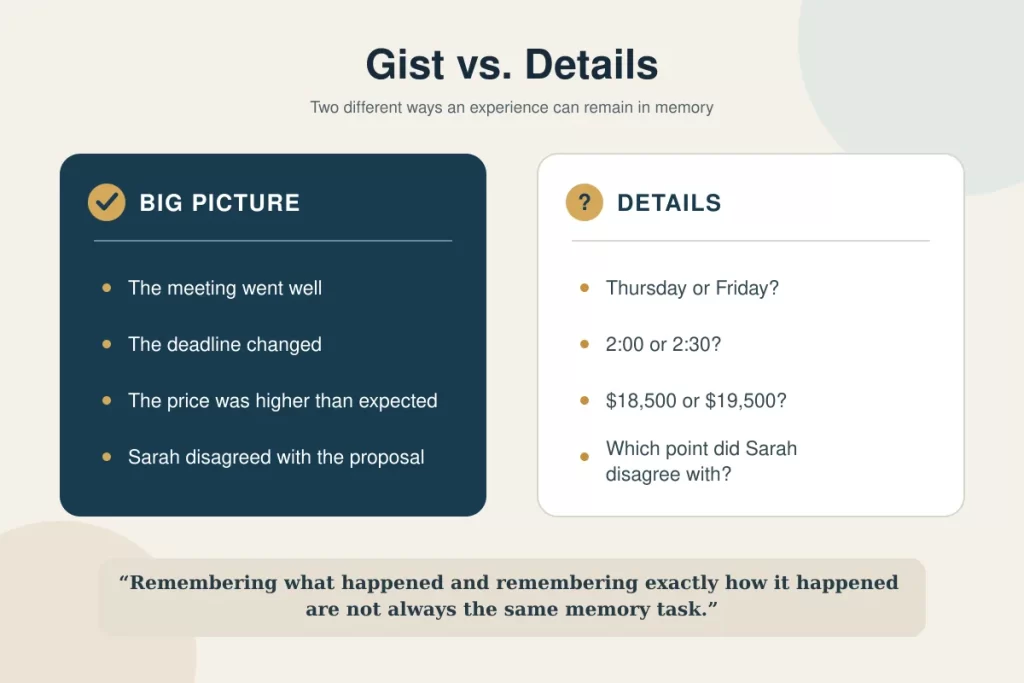
Memory researchers often distinguish between the general meaning of an experience—sometimes called its gist—and its specific details.
The gist answers:
What basically happened?
The details answer:
Exactly how did it happen?
Those are related forms of memory, but they are not identical.
And that distinction explains a surprisingly large number of everyday memory frustrations.
Understanding the difference between gist and detail helps answer the question, “Why do I forget details while still remembering the overall experience?”
The Big Picture Has More Ways Back
Specific details can be fragile.
Imagine someone tells you during lunch:
“The presentation has been moved to Thursday at 2:30 in Conference Room B.”
There are several separate pieces your brain could retain:
- the presentation was moved
- Thursday
- 2:30
- Conference Room B
An hour later, you may clearly remember:
The presentation changed.
But 2:30 has somehow become 3:00.
Or you remember Thursday but cannot remember the room.
The general meaning was connected to the larger conversation. The individual details had fewer mental connections supporting them.
The big picture often has many routes back into memory.
A precise number may have only one.
If you are asking, “Why do I forget details such as names, numbers, or times?”, one reason may be that those isolated facts have fewer connections leading back to them.
That is one reason you can feel certain you remember an event while still being uncertain about a particular detail.
This Can Become More Noticeable With Age
Healthy cognitive aging does not mean that everything about memory declines at the same rate.
Research on autobiographical memory and aging describes an age-related shift in which the broader gist of personal experiences may remain available even as specific episodic details become less prominent.
Vocabulary, accumulated knowledge, judgment, pattern recognition, and the broader meaning of experiences can remain quite strong.
Specific episodic details can become less dependable. Research examining memory for details and the overall structure of an experience also suggests that these two aspects of memory can behave differently with age.
This may explain why the question “Why do I forget details?” can become more common as people notice changes in the precision of their memories.
That creates an interesting experience:
You may understand situations extremely well while feeling less confident about exactly when, where, or how something occurred.
You remember the conclusion of the conversation but not the wording.
You remember that the restaurant was good but not its name.
You remember that the price was surprisingly high but not whether it was $189 or $219.
You remember the story.
The resolution is simply lower.
That does not make the memory useless.
In many situations, the gist is actually what matters most.
Experience May Make the Big Picture More Important
There is another side to this.
As you accumulate decades of experience, your brain has an enormous library of patterns to compare new information against.
You are often no longer processing an event as a collection of unrelated details.
You are asking:
What does this mean?
Have I seen something like this before?
Is this important?
What should I do with it?
That ability is valuable.
Someone with decades of business experience may leave a meeting unable to quote every number on a slide but immediately understand:
This deal has a problem.
Someone who has raised children may not remember every sentence in a conversation with a teenager but recognize immediately:
Something is bothering him.
The details matter.
But meaning matters too.
Memory is not only an archive of the past. It helps you interpret what is happening now.
But Sometimes the Details Really Matter
There are also situations where “close enough” is not enough.
A medication dose.
A bank account instruction.
A meeting time.
A password.
A contractual number.
A flight departure.
A client’s exact request.
These are situations where your brain should not be expected to decide automatically that the detail deserves permanent storage.
You have to signal:
This particular piece matters.
That starts with attention.
When accuracy matters, asking “Why do I forget details?” should lead you to examine whether the information received enough attention in the first place.
As we discussed in our article Why Is It Harder to Remember New Information After 50?, information must first receive enough attention to be encoded clearly before you can expect to retrieve it later.
If someone gives you an important number while you are reading an email, checking your phone, thinking about your next meeting, and preparing a response, you may retain the general message without securely capturing the number.
Later, it feels like the detail disappeared.
But it may never have been encoded strongly in the first place.
Mental Load Can Lower the Resolution of Memory
Imagine taking a photograph while moving.
The subject may still be recognizable.
The finer details become blurry.
Something similar can happen when you are trying to take in information while mentally overloaded.
You hear the conversation.
You understand it.
You respond appropriately.
But your attention is also carrying:
- an unfinished task
- three notifications
- something you need to remember later
- the next thing you plan to say
- another problem running quietly in the background
Mental overload is another useful answer when you wonder, “Why do I forget details during busy or stressful days?”
Your brain may capture enough information to understand the situation without capturing every part of it equally well.
That is why mentally crowded days can leave you with many memories that feel approximately right but strangely incomplete.
It also helps explain why you can forget what you just read even though the paragraph made perfect sense while you were reading it.
Understanding something in the moment does not guarantee that every detail became a durable memory.
Stop Asking Your Brain to Remember Every Detail
There is a temptation, especially when you become more aware of memory changes, to start testing yourself constantly.
What was his name?
What time did she say?
What was the exact number?
Why don’t I remember?
That can make normal memory feel like a constant examination.
Constantly asking “Why do I forget details?” can turn ordinary moments of forgetfulness into a stressful test of your memory.
A more useful approach is to decide which information actually deserves detail-level memory.
Most of yesterday does not.
You probably do not need to remember what time you ate lunch or what color shirt someone wore.
Your brain is doing you a favor by not preserving every detail of every ordinary experience equally.
Instead, identify the details that matter.
Then give those details better conditions for being remembered.
Try the “One Detail” Rule
When something important happens, pause for a moment and ask:
What is the one detail I absolutely need later?
Maybe it is:
“Thursday at 2:30.”
“$18,500.”
“Call Robert.”
“Bring the passport.”
Then give that information your complete attention for several seconds.
Repeat it.
Connect it to something.
Write it down if accuracy matters.
The goal is not to photograph the entire experience.
It is to increase the resolution around the part you actually need.
Retrieve the Detail Before Looking It Up
There is another useful habit.
Before immediately checking your notes, give yourself a moment to retrieve the information.
What was the number?
What was the person’s name?
What were the three things we decided?
Then check your answer.
Retrieval is different from recognition.
Seeing “Thursday at 2:30” and thinking, “Yes, that’s it,” can make information feel familiar.
Trying to produce “Thursday at 2:30” before looking requires your brain to find the pathway back to the information.
That effort is part of learning.
This is one reason retrieval plays such an important role in the learning strategies discussed in Can Your Brain Still Change After 50?
You do not need to turn everyday life into a memory exercise.
If you regularly wonder, “Why do I forget details shortly after hearing them?”, practicing retrieval may help strengthen the pathway back to important information.
But when something genuinely matters, briefly retrieving it can be more useful than repeatedly rereading it.
Use Meaning to Hold Onto Details
Specific information becomes easier to organize when it has somewhere to belong.
Instead of remembering:
$18,500
Remember:
The repair estimate was $18,500—about $1,500 below the $20,000 number I expected.
Instead of:
Thursday at 2:30
Think:
Thursday afternoon, right after lunch.
Instead of trying to memorize someone’s name as an isolated sound, connect it with where you met, what you discussed, or something distinctive about the interaction.
Meaning creates more ways back to the information.
You are not simply storing another isolated fact.
You are attaching it to a network that already exists.
Let Tools Protect the Details
Some information should not depend on memory at all.
If getting a detail wrong would create a meaningful problem, write it down.
Use the calendar.
Save the confirmation.
Put the number in the contact.
Create the reminder.
This is not giving up on your memory.
It is assigning different jobs appropriately.
Your brain is excellent at understanding patterns, extracting meaning, solving problems, connecting ideas, and making judgments.
Your calendar is excellent at remembering that the dentist appointment is Wednesday at 10:40.
Let each one do what it does well.
When Changes Deserve More Attention
It can help to understand the difference between normal age-related forgetfulness and memory problems that deserve attention.
Occasionally forgetting a detail is different from experiencing cognitive changes that increasingly interfere with normal responsibilities.
If memory changes are worsening or beginning to affect things such as managing finances, following familiar procedures, navigating known places, taking medications safely, or maintaining everyday independence, discuss them with a qualified healthcare professional.
The important distinction is not whether you occasionally forget something.
Everyone does.
It is whether the pattern is substantially changing your ability to function normally.
Where Lumultra Fits
Memory does not begin at the moment you try to remember something.
It begins earlier—with attention, working memory, mental clarity, and the ability to stay engaged long enough for information to be processed.
Lumultra is designed to support cognitive functions including focus, working memory, mental clarity, and everyday cognitive performance.
That does not mean a supplement can decide which details matter for you or guarantee that you will remember them.
The research behind gist and detail memory does not test Lumultra.
But if your interest in memory is part of a broader desire to feel more focused, mentally present, and cognitively engaged, Lumultra is designed to support that larger cognitive-performance picture.
The Bottom Line
You can remember a conversation without remembering every sentence.
You can remember a trip without remembering every restaurant.
You can remember the lesson without remembering every example.
Memory is not an exact recording of experience.
It preserves some things better than others.
And as you get older, the contrast between remembering what happened and remembering every detail of what happened may become more noticeable.
So when a small detail disappears, do not judge your entire memory by that one missing piece.
Ask instead:
Did I remember what mattered?
And when the precise detail truly does matter, give your brain—and your external tools—a clear signal that this one is worth keeping.