
Why writing things down helps you remember becomes clearer when you notice when forgotten tasks return. The package comes to mind when you pull into your driveway, the meeting question returns five minutes too late, and the unanswered message surfaces as you turn out the light.
This helps explain why writing things down helps you remember: the note moves part of the memory task outside your head and creates a cue you can encounter later.
The difference between “Insurance” and a complete instruction shows why writing things down helps you remember. A specific note gives your future self a recognizable action instead of another decision to make.
Understanding why writing things down helps you remember can help you build better reminders. Write the action clearly, connect it to the right time or place, and make sure the details you need are easy to find.
If this sounds familiar, it helps to look at the timing of your reminders. Writing things down helps you remember to act when the note becomes a cue you encounter at the right moment.
“Mail the package” on a page you never reopen cannot do much for you. The same note attached to your keys has a chance to catch you before you leave.
Remembering an Intention Is Its Own Kind of Memory Task
Remembering to carry out a future action is called prospective memory. It includes remembering to make a call, bring a document, or do something at a particular time.
One way people support this process is by placing part of the job outside their heads: in a calendar, a written note, or an alert. Researchers call this intention offloading.
In experiments involving delayed intentions, participants performed better when they could create external reminders. They also used reminders more often when the memory load or likelihood of distraction increased.
These findings support reminders as a practical aid; they do not show that making lists increases your underlying memory capacity.
External authority link:
Read the original research on external reminders.
For a related everyday experience, see why you forget what you were about to do.
Give the Reminder a Job
Think about the last task you remembered too late.
Where were you when you first decided to do it?
Where would you have needed to see the reminder?
Those may be two different places.
A note made during breakfast might need to reach you at your desk. A document you prepare at your desk might need to leave the house with you tomorrow.
Try treating each reminder as a short instruction for your future self.
It should answer three questions:
- What exactly do I need to do?
- When or where can I do it?
- What do I need in front of me?
This gives you something concrete to build, especially on days when every unfinished responsibility feels like another thing you must keep track of.
Our article on explores that related experience.
Turn a Vague Note Into an Action
“Insurance.”
You knew what that meant when you wrote it.
Tomorrow, you might have to work it out again.
Was there a bill to pay?
A form to find?
A question to ask?
Try:
“Call the insurer Tuesday at 10 a.m. to ask about the renewal; policy number is in the saved email.”
That is longer, but it leaves fewer decisions for later.
Here are a few practical examples:
| Vague Note | More Usable Reminder |
|---|---|
| Send file | After the 2 p.m. meeting, email the revised proposal to Alex. |
| Return package | Put the sealed return beside the work bag tonight; take it when leaving tomorrow. |
| Book appointment | At lunch Tuesday, call the clinic using the number saved in this reminder. |
| Ask about invoice | Add “confirm invoice due date” to the agenda for Thursday’s supplier call. |
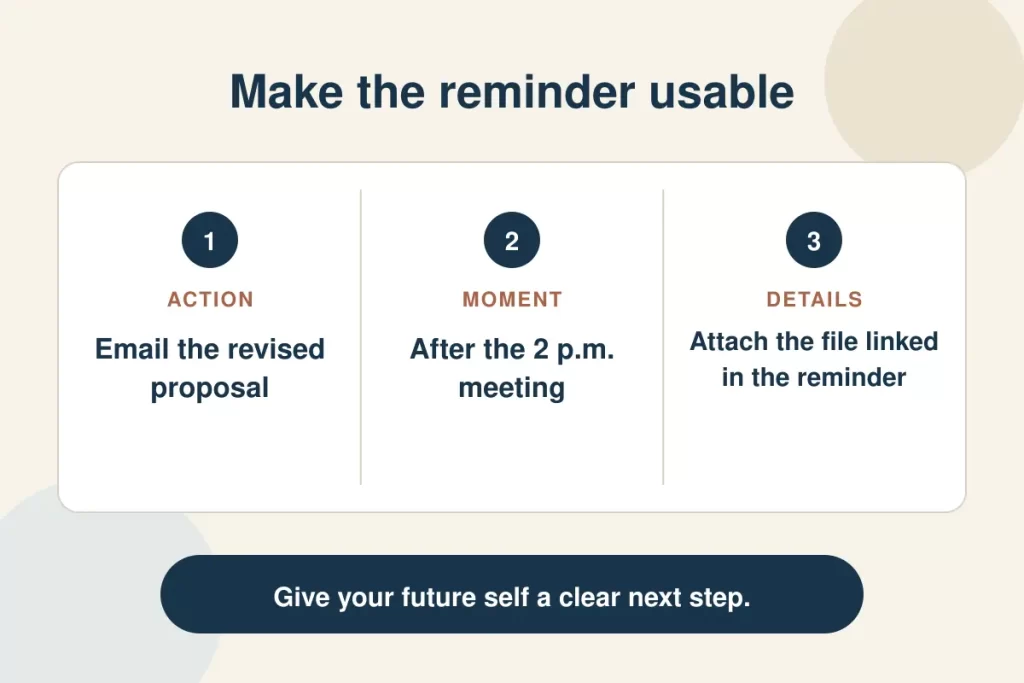
You are leaving yourself a next step you can recognize quickly.
Put the Cue Where the Action Can Happen
A reminder at 9 a.m. is awkward if you are driving and cannot act until noon.
For that situation, set it for a time when you expect to be available.
If plans change, reschedule it deliberately before dismissing it.
For something you need to take with you, place it safely beside an item you already collect before leaving.
For a question you need to ask, put it on the agenda you will open during the conversation.
An alert, an agenda item, and a package beside your bag serve different purposes.
Choose the one that matches the task.
The goal is simple:
Make the reminder available where you need it.
Make the System Easy Enough to Keep Using
You could build an elaborate collection of lists, labels, and reminders.
You could also spend more time organizing it than using it.
Start smaller.
Choose one place for loose tasks and keep appointments in the calendar you already check.
Give yourself a regular moment to review the task list, such as when you first sit down at your desk.
Research on reminder-setting offers a useful reason to care about convenience: in two experiments, people set fewer reminders when doing so required more physical effort.
Making a reminder easy to create can matter to whether you use it.
External authority link:
Read the study on reminder-setting effort.
For tomorrow, choose just one responsibility you keep remembering at inconvenient moments.
Write the action clearly.
Give it a time or a visible cue.
Then notice whether you encounter it when you can do something about it.
Using Support Does Not Have to Become a Judgment About Yourself
A shopping list is an ordinary tool.
So is a meeting agenda.
You can choose to use a reminder because a task matters to you, without treating the choice as a verdict on your abilities.
If you are exploring how to keep learning as you get older, our article Can Your Brain Still Change After 50? offers a related starting point.
Memory changes that worsen or interfere with everyday responsibilities deserve a conversation with a healthcare professional.
The National Institute on Aging explains the distinction between everyday forgetfulness and memory problems that need attention.
Make Room for the Part of the Day You Want to Engage With
Tomorrow morning, you may still have the same responsibilities.
But one well-placed reminder can give a recurring task a clear place and time.
That is a useful starting point for a more deliberate approach to your day.
If that same interest in everyday focus and memory brought you to Lumultra, you can explore the formula and product details as you consider your routine.
The reminder studies discussed here did not test Lumultra or establish a supplement benefit for remembering intentions.