
Someone explains something to you.
Maybe it’s a colleague describing three changes needed in a report. Maybe your spouse asks you to take care of a few things before leaving the house. Or maybe a technician walks you through the steps needed to fix a problem.
You listen. You understand everything. You even nod and say, “Got it.”
Then, a minute later, you try to follow the instructions. You remember the first step and what the request was generally about. But the second and third steps? Gone.
Didn’t they just tell me?
If you’ve wondered why you forget instructions seconds after hearing them, the explanation may have less to do with long-term memory than you think. The challenge often involves working memory—your brain’s ability to temporarily hold information while you’re using it.
Understanding Something Isn’t the Same as Remembering It
Here’s something many people don’t realize: you can understand information perfectly without successfully retaining it.
Imagine someone tells you: “Open the spreadsheet, update the October numbers, compare them with September, and send the revised version to Michael.”
You understand every instruction. But now you have four separate actions to remember. Your brain must hold those actions in mind, preserve their order, and organize how to complete them. That’s different from simply understanding the words.
The American Psychological Association’s overview of learning and memory distinguishes taking in information from retaining and retrieving it. Hearing is only the beginning. Keeping information available long enough to use it is another matter.
Your Brain Has a Temporary Mental Workspace
Working memory is often compared to a mental notepad. It holds information you need right now, especially when you must do something with that information.
You use it when you:
- Remember a phone number long enough to enter it.
- Follow a conversation with several details.
- Calculate something in your head.
- Compare two or three options.
- Keep track of multiple instructions.
- Remember what you were about to say.
But that mental notepad has limited space. It doesn’t just store information; it also helps you work with it.
Holding four digits for a few seconds may be straightforward. Holding four instructions while deciding which one to do first demands more attention and organization. A research review of working memory, executive function, and aging discusses how attention control and working-memory demands interact, including changes that can accompany aging.
The takeaway is simple: remembering instructions isn’t merely a test of whether you heard them. It’s a task involving several mental processes at once.
Why the Second and Third Steps Disappear
Consider what happens when someone gives you several instructions in a row.
First comes Step 1. Then Step 2. Then Step 3. While the other person is describing Step 3, you may already be thinking about how to complete Step 1.
Where is the document? Is there enough time? Did they mean the old version or the new one?
Now your brain is listening, remembering, planning, and interpreting at nearly the same time. Those demands can compete for limited attention. You might remember the purpose of the request but lose one of the exact actions.
This connects with our earlier article on why you remember the big picture but forget the details. Knowing what a conversation was about doesn’t guarantee that you can reconstruct every instruction in the correct order.
Why Distractions Make Verbal Instructions Harder to Remember
Now imagine receiving those instructions while checking your phone, listening to the television, or rushing to your next meeting.
Even if you believe you’re listening, some of your attention may be occupied elsewhere. The result isn’t always that you fail to hear the words. Sometimes you hear them without keeping all of the steps available afterward.
Our article on why background noise makes thinking harder after 50 explores how competing sounds can add demands during listening and concentration.
The same general problem can happen with competing thoughts. A worried mind, an unfinished task, or a stream of notifications can compete with what someone is trying to tell you.
That is also why mental clutter can make an otherwise simple request feel unexpectedly difficult. Sometimes the instructions aren’t complicated; your mental workspace is simply busy.
Why Following Instructions Can Feel Harder as You Get Older
If spoken instructions feel harder to remember than they did years ago, age-related cognitive changes may be part of the explanation. But healthy aging doesn’t affect every thinking skill in the same way.
Vocabulary, experience, and accumulated knowledge can remain strengths. Meanwhile, some aspects of processing speed, attention, and working memory may become less efficient with age. People also vary widely in how these changes appear.
Research provides a useful example. A 2022 study published in Memory examined younger and older adults following instructions, including the role of performing actions while learning or recalling them. The findings suggest that how instructions are processed can influence performance.
That doesn’t mean everyone over 50 will struggle with verbal instructions, or that every lapse is caused by aging. It does show why the format of instructions and the strategies you use can matter.
Why Seeing an Action Can Help More Than Just Hearing It
Imagine someone explains how to operate an unfamiliar machine. They describe which button to press, which setting to select, and what to check afterward.
You may understand the explanation yet struggle to retain the sequence. Now imagine they demonstrate the steps while talking. You can connect each instruction with something visible or an action you perform.
The 2022 instruction-following study investigated benefits of actions during encoding and retrieval. Its results support exploring action-based approaches for certain kinds of instruction tasks, although they do not guarantee that demonstrations will help in every situation.
When practical, try to connect an instruction with something you can see or do:
- Follow along as a person demonstrates a computer setting.
- Perform the first step while the explanation is fresh.
- Ask for a brief written example when accuracy matters.
- Turn a spoken sequence into a small checklist.
Instead of keeping a string of disconnected words in mind, you give yourself a concrete sequence to follow.
The 20-Second Handoff: A Simple Way to Remember Instructions
The next time someone gives you several instructions, change what happens immediately afterward. Rather than saying “Got it” and moving on, take a few seconds to transfer the information into a usable form.
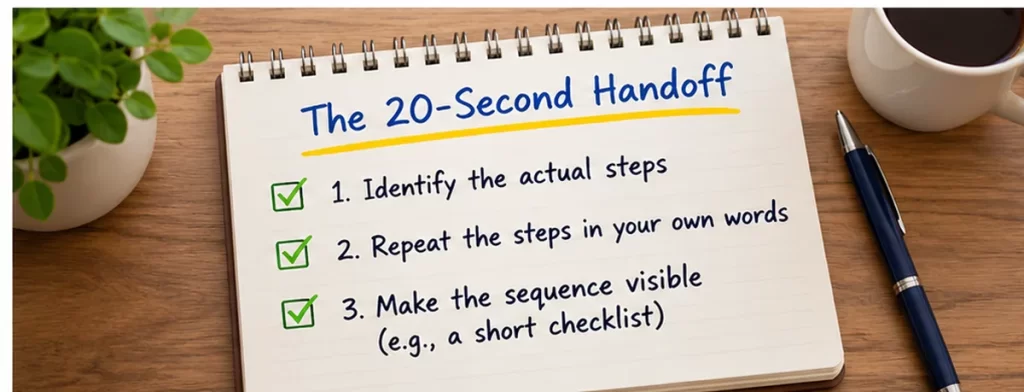
A simple three-step approach to turning spoken instructions into actions.
1. Identify the actual steps
Don’t just remember the subject. Identify the actions. “The spreadsheet needs updating” is the subject. “Update October, compare with September, and send the revised file” describes what to do.
2. Repeat the steps in your own words
Try saying: “Okay, first I update October. Then I compare the two months. Then I email the revised file.” If anything is missing or out of order, the other person can correct it before you begin.
3. Make the sequence visible
For instructions involving several steps, write a short checklist. It doesn’t need to be elaborate:
Update October numbers → Compare with September → Send revised file
Our article on why writing things down helps you remember to act explores how reminders and action cues can reduce the burden of remembering everything at the right moment.
4. Start the first action when practical
If you can begin immediately, open the document, gather the materials, or set up the first step. Moving from an abstract verbal instruction to an action can reduce how much information you need to keep in mind.
Not every situation allows you to begin right away. That’s when a written checklist or reminder is especially helpful.
The purpose of this handoff isn’t to memorize every word perfectly. It’s to keep the next action from disappearing before you can use it.
Why Trying Harder to Remember Isn’t Always the Answer
When people become frustrated with forgetfulness, they may assume they simply need to concentrate harder. Sometimes deliberate attention helps. But effort alone doesn’t remove working-memory limits.
If someone gives you eight unfamiliar steps while you’re distracted, telling yourself to “remember harder” is unlikely to be the most reliable strategy.
Instead, try reducing how much information must be held at once. Request instructions in smaller sections. Ask for a written summary when precision is essential. Repeat the sequence before the conversation ends. Capture key steps before switching to something unrelated.
These strategies can be useful at work, where missing an instruction may contribute to small mistakes at work. The goal isn’t perfect memory; it’s a dependable system for important details.
What About Memory Changes After 50?
Occasionally forgetting a spoken instruction doesn’t automatically mean you have a serious memory problem. Sleep difficulties, stress, divided attention, hearing problems, medication effects, and other health factors can influence how information is processed.
The National Institute on Aging’s guide to memory problems, forgetfulness, and aging explains that occasional forgetfulness can accompany normal aging, while changes that interfere with everyday activities may deserve medical evaluation.
If you increasingly struggle to follow familiar directions, manage routine responsibilities, or complete tasks you previously handled easily, discuss the changes with a healthcare professional. Sudden confusion or abrupt changes in thinking require urgent medical evaluation.
The important thing is the overall pattern—not one frustrating moment.
Supporting the Mental Clarity You Rely On
Remembering spoken instructions depends on more than one cognitive skill. You need attention to take in the information, working memory to hold it temporarily, and enough mental bandwidth to organize what comes next.
That is why practical cognitive-wellness habits are worth considering together. Sleep, exercise, manageable distractions, effective reminders, and routines that reduce unnecessary mental load can all form part of your approach.
For readers exploring supplements as part of their wellness routine, Lumultra is the brand’s cognitive-support formula, while Lumultra Nova is positioned as an energy-support formula.
Neither product should be presented as a proven treatment for forgetting instructions. The research described in this article did not test either formula, and supplements are not substitutes for appropriate medical advice, sufficient sleep, or effective memory strategies.
Explore Lumultra and Nova to learn more about the available formulas and subscription options.
Eligible new subscription orders may qualify for 30% off the first subscription purchase with code NEWU26. Check the current offer terms before ordering.
The Bottom Line: Remember the Action, Not Just the Conversation
When instructions disappear moments after you hear them, remember what your brain was being asked to do: listen, interpret, organize, remember, and possibly plan several actions at once.
That’s a demanding task for a limited mental workspace. Fortunately, you can make important information easier to use by asking for manageable steps, repeating actions in your own words, connecting words with demonstrations, and writing down anything that needs to be exact.
Sometimes the difference between forgetting an instruction and following it successfully is what you do with the information in the first few seconds after hearing it.
Frequently Asked Questions
Why do I forget instructions immediately after hearing them?
You may understand the information but struggle to hold and organize all the steps in working memory. Distractions, mental workload, fatigue, stress, and instruction complexity can contribute.
Does forgetting verbal instructions mean my short-term memory is getting worse?
Not necessarily. Following multi-step instructions depends on attention and working memory as well as recall. Persistent or worsening changes, especially those affecting daily life, should be discussed with a healthcare professional.
Can aging make it harder to follow multiple instructions?
Some working-memory and processing demands may become harder with age, but experiences vary widely. Demonstrations, smaller instruction sets, and written reminders can make certain tasks easier to manage.
What’s the easiest way to remember multi-step instructions?
Identify the actions, repeat them in your own words, write a short checklist, and begin the first step when possible. For safety-critical or complicated tasks, use verified written directions rather than relying on memory alone.
These statements regarding dietary supplements have not been evaluated by the Food and Drug Administration. These products are not intended to diagnose, treat, cure, or prevent any disease.