
You have five things to remember.
Call David.
Pick up the prescription.
Send the document.
Buy coffee.
Confirm tomorrow’s appointment.
A few minutes later, someone asks what was on your list.
You remember the first thing.
You remember the last thing.
But somewhere in the middle?
Something disappeared.
That pattern may feel random, but psychologists have been studying it for decades. It is called the serial position effect.
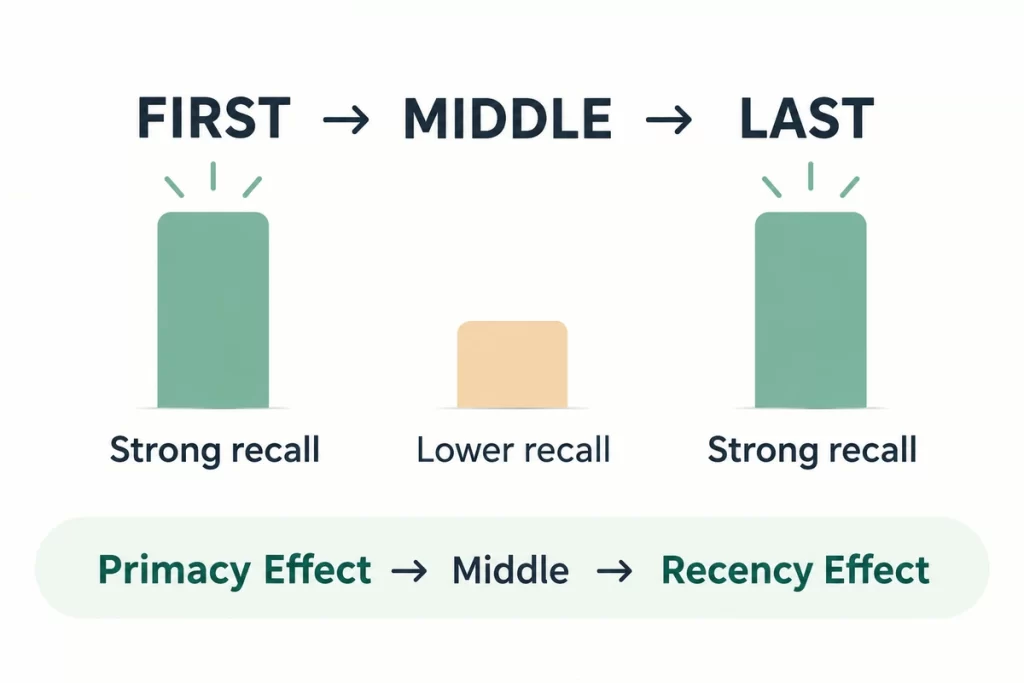
When people are asked to remember a sequence of information, items appearing near the beginning and end are often recalled better than items appearing in the middle.
The stronger memory for early information is called the primacy effect.
The stronger memory for information near the end is called the recency effect.
Together, they reveal something surprisingly useful about memory:
Where information appears can influence how easily you remember it.
What Is the Serial Position Effect?
Imagine hearing a list of twelve unrelated words.
You listen carefully. Then someone asks you to repeat as many as possible.
You probably won’t remember each word equally well.
Research on the serial position effect has repeatedly found a characteristic pattern: people tend to recall more items from the beginning and end of a list than from the middle.
Researchers call this pattern the serial-position curve. A psychology textbook explanation of the serial-position curve illustrates how early and late items can receive a recall advantage.
That doesn’t mean the brain has a rule saying:
“Forget the middle.”
Instead, information appearing at different points in a sequence encounters different memory conditions.
That distinction matters.
Because forgetting the middle of a list is not necessarily evidence that your memory is failing.
It can be part of the normal way memory works.
Why the Beginning Can Stick: The Primacy Effect
The tendency to remember the beginning of a sequence is called the primacy effect.
One traditional explanation is surprisingly intuitive.
When the first item arrives, nothing else is competing with it yet.
You have an opportunity to think about it.
Maybe you repeat it mentally.
Then the second item arrives.
You may repeat both.
The early items can therefore receive more attention or rehearsal before the sequence becomes crowded with additional information.
Researchers continue to debate the exact mechanisms behind primacy and recency. They shouldn’t be treated as two simple switches in the brain.
But the practical observation is consistent:
Early information often has an advantage.
Think about introductions.
Someone says:
“Before we begin, there are three things you need to know.”
Your attention is probably high.
The first point arrives in a relatively uncluttered mental environment.
By point seven of a long explanation, the situation is different.
You are now trying to remember what you already heard while simultaneously processing what is coming next.
This is one reason connecting new information to what you already know can be helpful. Giving an unfamiliar idea meaningful context may provide additional ways to retrieve it later.
Why the Last Thing Can Stick Too: The Recency Effect
Then there is the opposite end of the list.
The final items often receive their own advantage.
This is called the recency effect.
When someone finishes a list and immediately asks you what you remember, the final information is still relatively recent.
You may still have some of it active and accessible.
That can make the end of a sequence easier to retrieve than information buried several items earlier.
Think about a conversation.
Someone gives you six instructions.
You might remember:
- The first instruction.
- Several pieces of the conversation.
- And the final reminder.
“Oh, and don’t forget to bring your passport.”
That final instruction may feel unusually easy to remember.
Its position helped make it distinctive.
However, recency is not guaranteed. A delay or a distracting activity can change how well the final items are recalled.
The research on primacy and recency effects explains how the timing of recall and intervening tasks influence these patterns.
Why Information in the Middle Is Easier to Forget
Now look at what happens to the middle.
The middle doesn’t have the clean beginning.
It doesn’t have the freshness of the end.
Instead, middle items are surrounded by competing information.
New information arrived before them.
More information arrived after them.
They may receive less rehearsal and be less distinctive from neighboring items.
So when you later attempt to retrieve the sequence, the middle can become the vulnerable zone.
You’ve probably experienced this without realizing it.
Someone tells you:
“The meeting is Tuesday at 2. Bring your sales numbers, the revised proposal, the customer notes, and your laptop. We’ll meet in Conference Room B.”
Later you remember:
- Tuesday at 2.
- Conference Room B.
- Your laptop.
What disappeared?
Possibly one of the details sitting quietly in the middle.
In controlled experiments, these differences form a recognizable recall pattern. A Baylor University educational resource on serial-position effects explores how researchers study recall across different positions in a list.
Everyday situations are more complicated than laboratory word lists, but the underlying observation offers a useful way to think about information overload.
Don’t Turn This Into a Memory Test
There is an important distinction here.
The serial position effect is a well-established experimental finding.
It is not a do-it-yourself neurological test.
Forgetting the middle item on your grocery list does not diagnose anything.
Likewise, deliberately testing yourself with word lists isn’t a reliable way to decide whether your memory is normal.
Everyday memory is affected by attention, familiarity, stress, sleep, distractions, meaning, and many other factors.
The useful lesson isn’t to test your brain.
It’s to understand one more characteristic of how memory behaves.
And once you understand it, you can work with it.
How to Remember Important Information in the Middle
You cannot eliminate the serial position effect.
But you can stop treating every piece of information as though its position doesn’t matter.
1. Put the Most Important Thing First
If you are giving yourself instructions, writing meeting notes, or creating a short task list, consider what absolutely cannot be forgotten.
Don’t automatically bury it halfway down the page.
Give important information prominence.
Your first position is valuable real estate.
Use it.
For example, instead of writing:
“Pick up coffee, send the report, buy batteries, confirm the doctor’s appointment, and check the mail.”
Try:
“Confirm the doctor’s appointment first. Then handle the remaining errands.”
The important action now stands out rather than competing with several routine tasks.
2. Break Long Information Into Smaller Sections
Suppose you have twelve things to review.
One uninterrupted sequence gives you:
Beginning → Long Middle → End
Instead, dividing the material into several meaningful groups gives the information more structure.
For example:
Before the meeting:
- Review the agenda.
- Prepare the financial report.
- Confirm the participants.
During the meeting:
- Discuss the proposal.
- Review feedback.
- Assign responsibilities.
After the meeting:
- Send the summary.
- Update the project schedule.
- Confirm the next meeting.
You’re no longer asking your brain to deal with one anonymous block of information.
You’re giving it organized sections.
This also connects with another important memory principle: information can become easier to work with when it has meaningful structure.
Grouping information is not a guarantee that every item will be remembered. It is a practical way to reduce unnecessary complexity and make important details easier to locate.
3. Pay Special Attention to the Middle
Here’s a simple habit:
After hearing several important instructions, ask yourself:
“What were the middle things?”
Don’t immediately review the entire list from the beginning.
Try retrieving the items that are most likely to disappear.
For example:
“I know the first instruction was to call Robert, and the last was to send the invoice. What were the two things between them?”
Now you’re using retrieval practice for memory strategically instead of treating every item equally.
Trying to retrieve information before checking your notes can be useful when you genuinely want to remember it later.
But remember to verify the answer.
The goal is to practice accurate recall, not to become more confident in an incorrect detail.
4. Make an Important Middle Item Distinctive
If something important is buried among several other pieces of information, give it an additional cue.
- Say it aloud.
- Connect it with something you already know.
- Write it separately.
- Explain why it matters.
- Move it into its own category.
You’ve already seen these principles in some of our recent memory articles.
The goal isn’t to turn everyday life into a memory-training exercise.
It’s simply to recognize when something important deserves more attention.
You can also reinforce important information by revisiting it after a delay using the spacing effect, rather than repeating it several times in one sitting.
Try the First-Middle-Last Memory Check
Here’s an easy habit you can use after a meeting, conversation, article, or set of instructions.
Ask yourself three questions:
FIRST: What Was the First Important Idea?
Start by identifying the opening point.
What did the person say first?
What was the beginning of the explanation about?
Try to recall it without immediately checking your notes.
MIDDLE: What Information Was Buried Between the Beginning and End?
This is the most important part of the exercise.
Think about the details that came after the introduction but before the conclusion.
What instructions were mentioned?
Was there a number, name, deadline, or important decision?
Don’t rush to the final point before giving the middle information a chance to come back.
LAST: What Was the Final Important Point?
Finally, recall the ending.
What was the last instruction or recommendation?
Was there a final reminder or action item?
Once you’ve attempted all three, compare your answers with the original information when possible.
First → Middle → Last → Check
Many people naturally find the first and last questions easier in list-recall situations.
That’s exactly why the middle question can be useful.
It directs attention toward information that might otherwise disappear quietly.
This First-Middle-Last check is a practical suggestion based on memory principles, not a clinically validated memory-training program.
What the Serial Position Effect Teaches Us About Reading
Reading provides another opportunity to think about information order.
You begin an article.
The introduction captures your attention.
You read several sections.
Then you reach the conclusion.
Later, you remember the opening idea and the final takeaway.
But what about the explanations and examples in between?
The classic serial position effect comes from controlled recall experiments, so it doesn’t automatically predict exactly which paragraphs of an article you’ll remember.
Still, it offers a useful reminder that long sequences of information can become difficult to manage.
Instead of reading continuously and hoping everything sticks, consider pausing after meaningful sections.
Ask yourself:
“What was the point of that section?”
Try explaining it in one sentence.
Then continue.
This approach works naturally with the strategies discussed in our article Why You Read a Page and Remember Nothing, which explains how attention, encoding, and active recall influence reading comprehension.
This Also Matters When You’re Communicating
The serial position effect isn’t only useful when you’re trying to remember.
It can also change how you present information to other people.
Suppose you’re sending someone five instructions.
If one instruction is absolutely critical, hiding it in the middle of a long paragraph may not be ideal.
Give it emphasis.
Put it near the beginning.
Separate it visually.
Or reinforce the key point at the end.
The same idea applies to presentations, meetings, instructions, and conversations.
For example, imagine explaining a new process to your team.
Instead of delivering ten instructions without interruption, you could:
- Begin with the main objective.
- Divide the instructions into meaningful stages.
- Highlight important requirements within each stage.
- Finish with the most important next action.
This doesn’t guarantee that your audience will remember everything.
But it makes the information easier to navigate and reduces the chance that important details become lost inside a long explanation.
Sometimes clearer communication isn’t about saying more.
It’s about deciding where the important information goes.
Where Lumultra Fits
Memory isn’t one isolated ability.
For information to become useful later, your brain first has to pay attention to it, process it, organize it, and eventually retrieve it.
Those processes also depend on cognitive functions such as focus, working memory, and mental clarity.
That is why memory strategies work best as part of a broader routine that supports cognitive well-being.
Lumultra is formulated to support cognitive functions including focus, memory, processing speed, and mental clarity as part of a daily cognitive-support routine.
It isn’t a replacement for good learning strategies, adequate sleep, regular exercise, effective organization, or appropriate medical care.
Think of strategies like the First-Middle-Last check as ways to use your cognitive resources more deliberately.
Lumultra is designed to support the broader cognitive foundation behind everyday mental performance.
The Takeaway: Remember What Gets Lost in the Middle
Memory does not necessarily give every piece of information equal treatment.
The beginning of a sequence may benefit from greater opportunity for attention and rehearsal.
The end may benefit from being especially recent.
The middle can get squeezed between the two.
So the next time you need to remember several important things, don’t simply repeat the entire list again.
Ask:
“What is hiding in the middle?”
Pull that information out.
Give it meaning.
Try retrieving it.
And make sure the information that matters most isn’t the easiest thing to overlook.
Sometimes remembering better begins with understanding where forgetting is most likely to happen.
Support Focus, Memory, and Mental Clarity
Your daily mental performance depends on more than one memory trick.
Consistent habits, meaningful learning, adequate rest, and attention all contribute to the way you process and remember information.
Lumultra is designed to support the cognitive functions you rely on every day, including focus, memory, processing speed, and mental clarity.
Explore Lumultra and its cognitive-support formula →
Dietary supplements are not intended to diagnose, treat, cure, or prevent disease. Significant, sudden, or progressively worsening changes in memory or thinking should be discussed with a qualified healthcare professional.