
Someone tells you a name.
You repeat it silently in your head.
Five minutes later, it is gone.
You read the time of an appointment. You are certain you will remember it. Later that afternoon, you find yourself checking again.
Or you read an important sentence in a report, understand it perfectly, and discover the next day that almost none of the wording comes back.
But sometimes something different happens.
You say the information out loud.
“Thursday at 10:30.”
“Robert from Denver.”
“Call the accountant before Friday.”
And somehow it seems easier to retrieve later.
That may not be your imagination.
Researchers have studied a phenomenon known as the production effect: information that you actively say aloud can sometimes be remembered better than information you only read silently.
The explanation is surprisingly useful for everyday memory.
Saying Something Creates Another Memory Cue
When you silently read a piece of information, your brain processes the words visually and mentally.
When you say those same words aloud, you add something else.
You see the information.
You form the words.
You hear yourself saying them.
And because you produced the information yourself, it may become more distinctive from everything else you were processing at the time.
Researchers studying the production effect have found that selected words spoken aloud can be remembered better later than words studied silently.
That does not mean you should walk around narrating everything you want to remember.
The benefit appears to come partly from distinctiveness.
If everything becomes special, nothing is especially distinctive.
That makes this technique most useful for the few pieces of information that actually matter.
Why Important Information Disappears So Easily
Memory does not begin when you try to remember something later.
It begins when the information first enters your attention.
Imagine someone gives you three instructions while you are:
- checking your phone,
- thinking about another problem,
- watching someone walk past,
- and deciding what you need to do next.
You may technically hear all three instructions.
But hearing something is not the same as giving your brain a strong opportunity to encode it.
This is one reason people occasionally interpret an attention problem as a memory problem.
The information did not necessarily disappear from memory. It may never have been strongly established there in the first place.
That is also why reading the same sentence repeatedly does not always solve the problem.
Passive exposure can create familiarity without creating reliable recall.
Something can look very familiar and still be surprisingly difficult to retrieve when the page is no longer in front of you.
Saying It Out Loud Forces a Small Moment of Attention
Try this with a piece of information you actually need later.
Instead of simply looking at:
Dentist — Thursday — 3:00 PM
say:
“Dentist. Thursday at three.”
That tiny action forces you to interact with the information instead of merely noticing it.
You have to select the words, produce them, hear them, and briefly hold their meaning together.
This creates a stronger event around the information.
The point is not that your voice has magical memory-enhancing properties.
The benefit comes from what producing the information makes your brain do.
There Is an Important Difference Between Remembering and Understanding
Reading something aloud may make certain information more memorable.
That does not necessarily mean you understand it better.
Researchers examining longer passages have found that reading aloud can improve memory for material without producing the same advantage for comprehension.
This distinction matters.
Suppose you are trying to understand a complicated investment document.
Reading one important definition aloud may help you remember the wording.
But that does not automatically mean you understand the financial implications.
For understanding, you still need to:
- connect ideas,
- ask questions,
- compare information,
- and explain the concept in your own words.
Memory and comprehension work together, but they are not identical.
For more detail, see this research on reading text aloud, memory, and comprehension.
An Even Better Trick: Say It Without Looking
There is another important memory principle here.
After you encounter something important, stop looking at it for a moment and try to retrieve it.
Instead of reading:
“Meeting moved to Wednesday at 2:00.”
five times, look away and ask:
“When is the meeting?”
Then answer:
“Wednesday at two.”
That small act changes the task.
You are no longer simply exposing yourself to the information.
You are practicing finding it.
Research on retrieval practice has found that attempting to retrieve recently learned information can strengthen later retention more effectively than simply restudying it.
This is why quizzing yourself can sometimes be more useful than rereading.
You are practicing the exact ability you will need later: getting the information back when the answer is no longer sitting in front of you.
Try the Read → Say → Recall Method
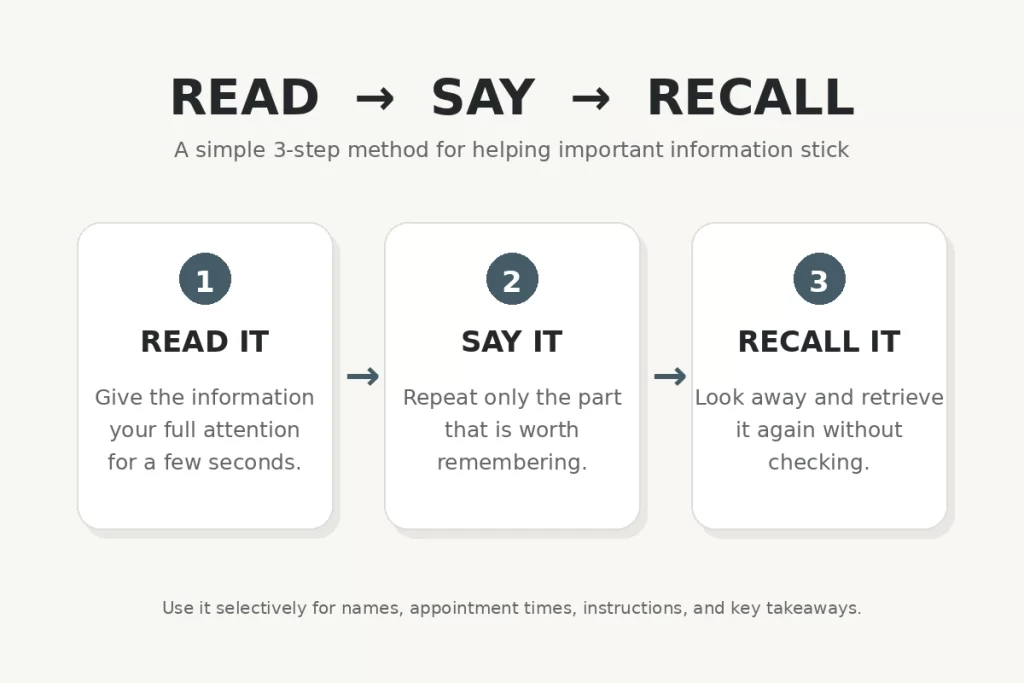
For information that really matters, use a simple three-step sequence.
1. Read It
Give the information your full attention for a few seconds.
2. Say It
Repeat the key information aloud in a simple form.
Not the entire paragraph. Just what you want to preserve.
3. Recall It
Look away.
Wait a few seconds.
Then say it again without checking.
READ → SAY → RECALL
For example:
You meet someone named Elizabeth who works with your accountant.
Instead of thinking:
“I need to remember her name.”
Try:
“Elizabeth. She works with David.”
Continue the conversation.
Thirty seconds later, mentally ask:
“What was her name?”
Elizabeth.
You have now done more than hear the name.
You have encoded it, produced it, and retrieved it.
What Kinds of Information Are Worth Saying Out Loud?
This technique works best when you are selective.
Good candidates include:
- names you genuinely want to remember,
- appointment times,
- a short instruction,
- an unfamiliar term,
- a phone number you need temporarily,
- a key takeaway from something you just read,
- a next step you cannot act on immediately,
- or one important detail from a conversation.
You probably do not need to vocalize your entire grocery list.
The purpose is to make selected information more distinctive.
Repeating a new name aloud can be especially useful when you meet someone you want to remember.
Combine Speaking With Writing When Something Really Matters
There is no rule saying you must choose between remembering something internally and using an external reminder.
Often, the smartest approach is both.
Suppose someone tells you:
“Bring the signed document Tuesday morning.”
You might say:
“Signed document, Tuesday morning.”
Then put a reminder next to your keys.
Writing things down gives you an external reminder, while saying the information gives your brain an additional encounter with it.
This is especially useful for responsibilities where forgetting has consequences.
Good memory systems do not require your brain to carry everything alone.
Why This Matters More Than Simply “Trying Harder”
When memory feels unreliable, the natural response is usually effort.
Concentrate harder.
Repeat something more times.
Force yourself to remember.
But better memory is often less about force and more about how information is processed.
Is the information receiving your attention?
Is it distinctive?
Did you actively retrieve it?
Did you create a useful cue for later?
These questions are often more productive than simply asking yourself to “remember better.”
Where Lumultra Fits
Memory techniques work best when the cognitive conditions around them are strong.
You still need enough attention to register information, enough working memory to hold it while using it, and enough mental clarity to separate what matters from everything competing for your attention.
Lumultra is formulated as daily cognitive support around those interconnected areas—focus, working memory, mental clarity, and overall cognitive performance.
It does not replace good sleep, useful memory systems, or habits such as retrieval practice.
Think of those behaviors as the strategy.
Lumultra is designed to support the cognitive foundation you are asking to carry out that strategy.
Because sometimes remembering more is not about forcing your brain harder.
It is about giving important information a better chance to stick.
Support clearer, more dependable cognitive performance with Lumultra.