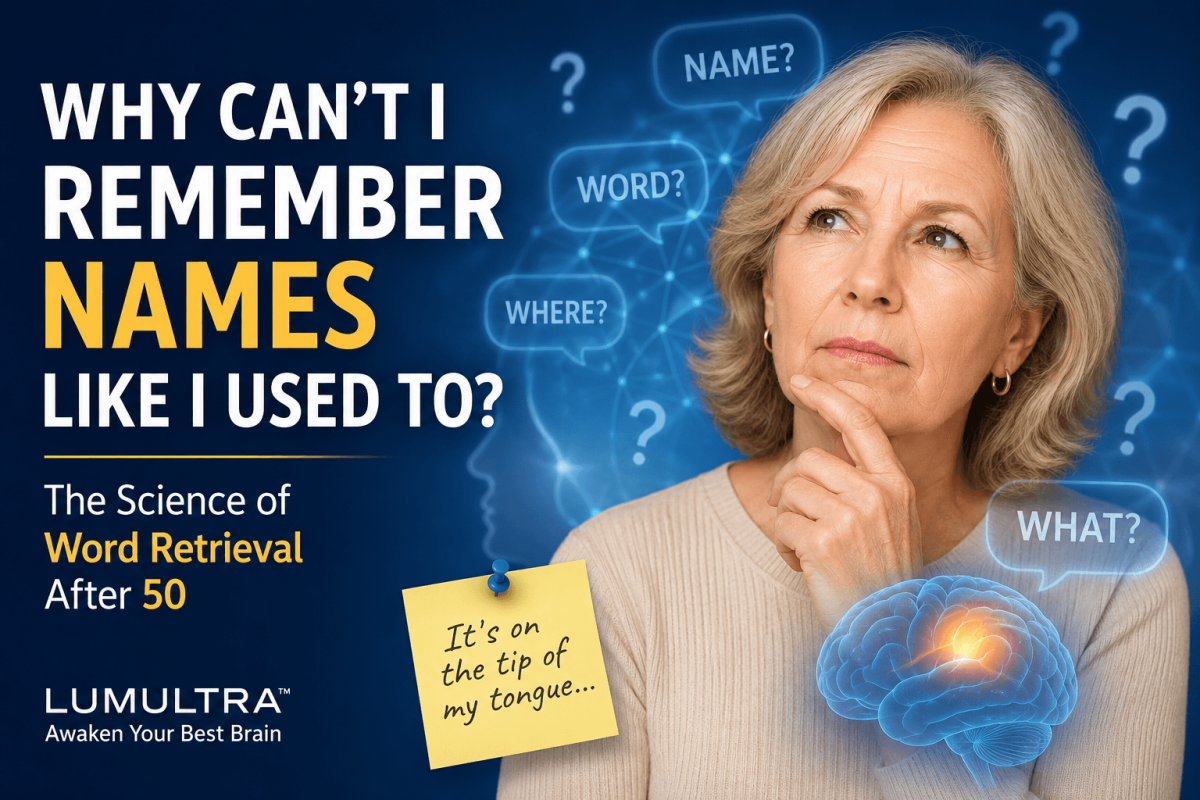
Remembering names after 50 can sometimes feel harder than it used to. You see someone you have known for years, recognize their face immediately, and remember where you met—but their name suddenly seems just out of reach.
You may even remember what they do for a living.
But their name?
Nothing.
It feels as though the answer is sitting just beyond reach.
Then, ten minutes later—usually when you are thinking about something completely different—the name suddenly appears.
If this happens more often than it used to, you are certainly not alone.
Researchers describe this familiar experience as a tip-of-the-tongue state: you know that you know a word or name, but temporarily cannot retrieve it. Word-finding and name-recall can also become slower with normal aging.
Importantly, occasionally struggling to find a word is not the same thing as losing the underlying knowledge.
Often, the information is still there.
The challenge is accessing it quickly.
Remembering Has More Than One Step
We tend to think of memory as one ability.
You either remember something or you don’t.
The brain is considerably more complicated.
Memory involves several different processes, including:
- Encoding — getting information into memory.
- Storage — maintaining that information.
- Retrieval — accessing it when you need it.
That distinction explains something many adults experience after 50.
You can recognize someone’s name instantly when another person says it:
“That’s right — David!”
Yet seconds earlier, you couldn’t produce “David” yourself.
The memory existed.
Your brain simply had difficulty retrieving it on demand.
This is also why recognizing an answer on a multiple-choice test can feel easier than producing the answer without any clues.
For more on the other side of memory—getting new information into memory—see our related guide.
Why Names Are Especially Difficult
Remembering names after 50 can feel especially frustrating because names are surprisingly demanding pieces of information.
Imagine meeting someone named Michael.
Knowing that he is your neighbor’s brother gives your brain useful context.
Knowing that he owns a restaurant creates another association.
But the word Michael itself does not tell you much about him.
Names often have fewer meaningful clues attached to them than ordinary words.
If you forget the word “hammer,” your brain can work backward:
It’s a tool… you hit nails with it…
Those associations help lead you toward the word.
A person’s name may provide far fewer clues.
That is one reason proper names can feel particularly vulnerable to temporary retrieval failures.
The Aging Brain May Need More Time to Find the Answer
Remembering names after 50 can become more challenging as some cognitive abilities change gradually with age, even while other abilities remain remarkably strong.
According to the National Institute on Aging, older adults may be slower to find words and recall names, experience more difficulty with multitasking, and notice mild changes in attention.
That does not necessarily mean vocabulary or knowledge has disappeared.
In fact, decades of learning can leave older adults with an enormous store of knowledge.
The challenge can instead become navigating that mental library quickly enough to retrieve exactly the right piece of information at exactly the right moment.
Think of it this way:
Your mental library may contain more books than ever.
Finding one particular book can sometimes take longer.
A noisy environment creates another challenge because your brain must separate the speaker’s voice from competing sounds before it can give the name enough attention to encode it.
Attention Matters Before Retrieval Even Begins
There’s another important piece of the puzzle.
Memory and attention constantly interact.
Suppose someone introduces herself while you are:
- checking your phone,
- listening to another conversation,
- deciding what to say next,
- thinking about work,
- or worrying about something else.
You may feel as though you “forgot her name.”
But your brain may never have encoded the name very strongly in the first place.
This is one reason memory problems can sometimes begin as attention problems.
If information enters the brain weakly, retrieving it later becomes much harder.
That makes sustained attention especially important.
The goal isn’t simply to “try harder to remember.”
It’s to give information enough attention that the brain has something strong to retrieve later.
For a deeper look at how divided attention can affect memory, read our guide on memory and attention when multitasking.
Why Trying Harder Can Sometimes Make the Word Disappear
You’ve probably experienced this:
You desperately try to remember a name.
You mentally repeat:
“Come on. What is it? I know this.”
And the harder you try, the further away it seems.
Then you stop thinking about it.
Five minutes later:
Susan.
There it is.
When the correct word isn’t immediately accessible, repeatedly forcing the search does not always help. Sometimes shifting your attention briefly can give you a mental reset.
That doesn’t mean giving up on your memory.
It means understanding that retrieval is not always instantaneous.
Four Ways to Make Names Easier to Retrieve
You cannot prevent every tip-of-the-tongue moment.
But you can make information easier for your brain to find.
1. Create an Association Immediately
When you hear a new name, connect it to something meaningful.
Instead of simply hearing:
Robert
Create an association:
Robert → golf → John’s brother
Now your brain has several pathways back to the information instead of one.
2. Use the Name
Say it naturally during the conversation.
“Nice to meet you, Robert.”
Repeating a new name aloud is more than polite conversation—it may also help make that name more distinctive in memory.
Using information requires more active processing than simply hearing it.
3. Remove Competing Input
If remembering something matters, give it your attention.
Trying to encode a name while simultaneously checking a message, following another conversation, and thinking about what happens next creates unnecessary cognitive competition.
4. Support the Conditions Your Brain Needs
Cognitive performance doesn’t operate independently of the rest of the body.
Sleep, physical activity, cardiovascular health, medications, mood, and other health factors can affect cognitive function. The National Institute on Aging recommends paying attention to overall health as part of supporting cognitive health as people age.
For more background, explore the National Institute on Aging’s brain health resources.
The objective isn’t perfection.
It’s creating better conditions for your brain to perform consistently.
The Bigger Question Isn’t Whether You Occasionally Forget a Name
Almost everyone experiences temporary word-finding failures.
The National Institute on Aging notes that occasionally forgetting which word to use can occur with normal aging.
The more useful question is:
How reliably does your brain give you access to the information you know?
For many adults, remembering names after 50 is where that frustration becomes especially noticeable.
They aren’t suddenly missing decades of knowledge.
They simply feel that their brain takes longer to deliver the answer.
A name arrives ten minutes late.
The perfect word appears after the conversation.
A thought is clear internally but difficult to express quickly.
That gap between knowing and accessing what you know is why supporting cognitive performance becomes increasingly important with age.
Supporting More Consistent Cognitive Performance
There is no single switch that controls memory.
Attention, working memory, mental energy, retrieval, sleep, stress, and overall health continuously interact.
That’s also why supporting cognitive performance requires a broader approach than simply memorizing more things.
At Lumultra, the focus is on daily cognitive support for people who want to support focus, memory, processing speed, and mental performance.
Lumultra is designed to support overall cognitive function, working memory, focus, and mental clarity as part of a broader daily routine.
It isn’t about expecting your brain to work exactly like it did at 20.
It’s about supporting the brain you have today and giving yourself better conditions for consistent cognitive performance.
Because sometimes the information isn’t gone.
Your brain just needs a clearer path back to it.
A Note About Memory Changes
Occasional difficulty finding a word or name can happen with normal aging. However, memory or language changes that become frequent, progressively worse, interfere with everyday activities, or make normal conversation difficult deserve medical evaluation.
The National Institute on Aging explains the difference between normal age-related forgetfulness and more serious memory problems and recommends talking with a doctor about changes that concern you.