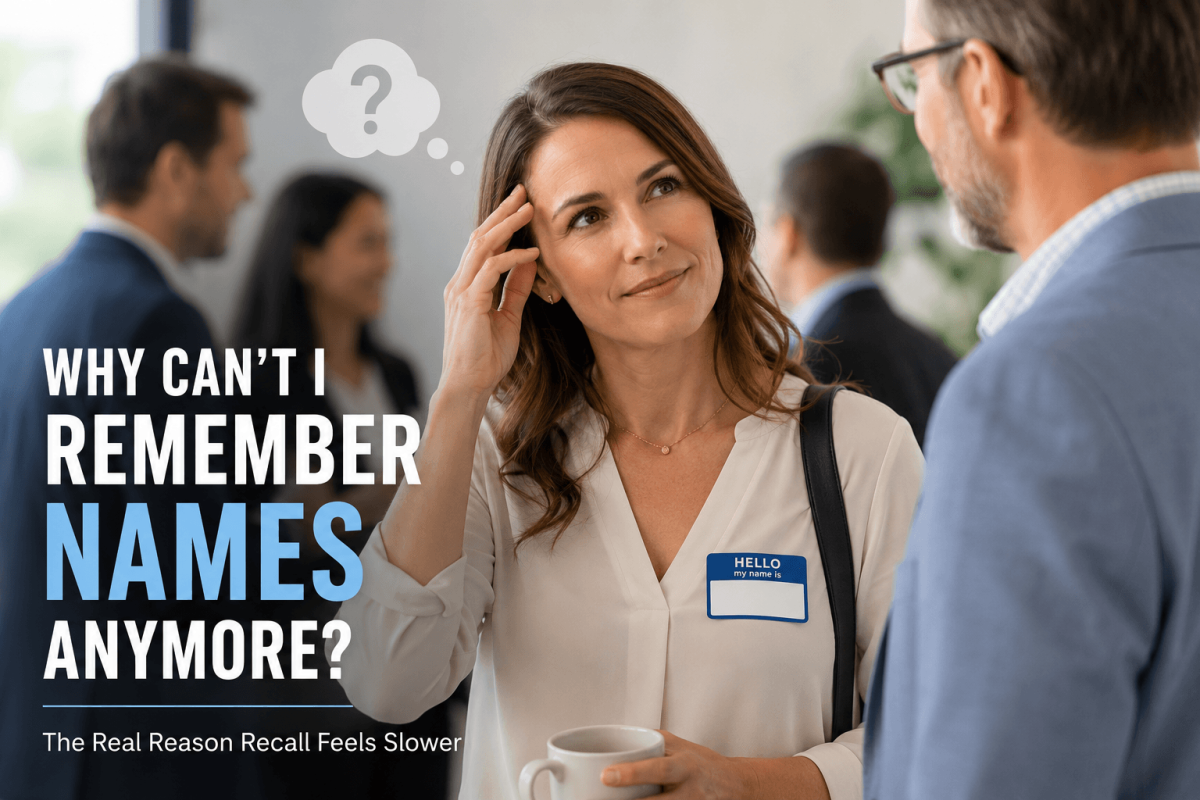
Why can’t I remember names the way I used to?
If you’ve been asking yourself why can’t I remember names, you’re experiencing one of the most common memory complaints among adults.
You meet someone, shake their hand, hear their name, and then five minutes later it is gone.
You know the face. The conversation is still clear in your mind. You might even remember where they work, what they were wearing, or the story they told you. But the name itself feels locked behind a mental door.
If you’ve found yourself wondering, “Why can’t I remember names anymore?”, you’re not alone. Name recall is one of the most common memory frustrations, especially for adults who still feel intelligent, capable, and high-functioning in every other area.
The good news is that forgetting names does not automatically mean your memory is failing. In many cases, it has less to do with “storage” and more to do with attention, mental load, stress, sleep, and the way your brain retrieves information under pressure.
The frustrating part is that name recall feels personal. Forgetting a task is annoying. Forgetting where you put your keys is inconvenient. But forgetting someone’s name can feel embarrassing, awkward, or even alarming.
So let’s break down what is really happening.
Remembering a Name Is Harder Than It Seems
Understanding why can’t I remember names starts with understanding how the brain stores and retrieves information.
A name feels like a simple piece of information. But to your brain, it is actually surprisingly difficult.
When someone tells you their name, your brain has to do several things almost instantly. It has to hear the sound clearly, pay attention to it, attach it to the person’s face, connect it to the context of the meeting, and store it long enough to retrieve later.
That is a lot of mental coordination for something that often happens during a distracted social moment.
You may be thinking about what to say next. Perhaps your attention is on the room around you. Many people are also trying to make a good impression. Sometimes you’re simply tired, overstimulated, or mentally juggling ten other things. By the time the person says, “Hi, I’m Sarah,” your brain may technically hear the name but never fully encode it.
The problem is not always that your memory lost the name. Sometimes your brain never properly filed it in the first place.
One reason people often say, “I’m terrible with names,” even though they remember faces, stories, appointments, and complicated work details just fine.
Names are arbitrary. A face may give you visual clues. A conversation may have meaning. A story has context. But a name often has no built-in logic unless you deliberately attach it to something.
That makes name recall more fragile than other kinds of memory.
Why Name Recall Can Feel Slower With Age
As people get older, many notice that recall feels less instant than it used to. The information may still be there, but it takes longer to access.
Name-recall problems are especially common with names, specific words, and small details. You know what you mean. The person’s face may be easy to picture. You may even remember the first letter of their name. But the full name does not appear when you want it.
This is sometimes described as a “tip-of-the-tongue” moment. It feels like the information is close, but not reachable.
The National Institute on Aging explains that some forgetfulness can be a normal part of aging, while memory problems that interfere with everyday life deserve more attention.
The key distinction is function.
Occasionally forgetting a name, misplacing glasses, or needing a moment to recall a word can be normal. But repeatedly getting lost in familiar places, struggling to follow directions, forgetting how to do everyday tasks, or experiencing major personality or judgment changes should be discussed with a medical professional.
For most people reading this, though, the issue is more subtle.
You’re not losing your life skills. Most people still know exactly who others are. Everyday functioning remains intact. You simply feel like recall is slower, less reliable, and more effortful than before.
That is exactly the type of mental performance gap many adults notice before they ever think of it as “memory decline.”
Attention Comes Before Memory
When people ask why can’t I remember names, attention problems during introductions are often a major part of the answer.
One of the biggest reasons people forget names is not poor memory. It is poor attention at the moment of introduction.
Memory does not begin when you try to recall something. Memory begins when you first take information in.
If your attention is scattered, your memory has less to work with.
Think about how often introductions happen when your mind is already busy. You are walking into a meeting, entering a party, joining a call, or being introduced to several people at once. In those moments, attention is often focused on the situation rather than the name itself.
You may hear the name but not register it deeply.
That matters because recall depends on encoding. Encoding is the process of turning new information into something your brain can store and retrieve later. If the name was weakly encoded, recall will feel difficult later.
This is why you might remember the name of someone you had a meaningful one-on-one conversation with, but forget the names of three people introduced to you quickly in a group.
Those names were not impossible to remember. Instead, your brain didn’t have enough attention available to attach each name to a strong mental cue.
Harvard Health notes that memory retrieval involves areas of the brain connected to attention and focus.
That is an important point for Lumultra’s audience: sharper memory is not just about “remembering better.” It often starts with focusing better.
Mental Load Makes Recall Worse
Another reason people wonder why can’t I remember names is that mental overload reduces the brain’s ability to encode and retrieve details efficiently.
Name recall also suffers when your brain is overloaded.
If you’ve ever felt like your brain feels busy all day but somehow accomplishes less than expected, you’re not imagining it. Mental overload can make even simple information like names harder to store and retrieve.
That mental load affects recall.
This may also explain why everything takes more effort during particularly demanding periods of life, even when your responsibilities haven’t dramatically changed.
When your brain is busy managing unfinished tasks, emotional stress, or constant stimulation, it has less capacity for small details. A person’s name may not seem important enough for the brain to prioritize in the moment.
Later, when you try to retrieve it, the name feels missing.
This does not mean your brain is broken. It means your cognitive bandwidth is being consumed.
Many people notice this pattern during especially demanding seasons of life. You may forget more names when you are sleeping poorly, traveling, managing stress, working long hours, or constantly switching between responsibilities.
The brain does not separate memory from the rest of your mental state. Recall is affected by energy, attention, emotional load, and recovery.
That is why the same person can feel sharp one week and mentally scattered the next.
Stress Can Block the Name You Know
There is another frustrating part of name recall: the harder you try, the more blocked it can feel.
Someone approaches. You know you should remember their name. A small wave of panic can follow. Then your mind goes blank.
That pressure can make recall worse.
When stress rises, your brain shifts away from relaxed retrieval and toward threat management. Even mild social anxiety can interfere with recall. The name may still be stored, but the mental state you are in makes it harder to access.
This is why the name often comes back later when you are no longer trying. You are driving home, taking a shower, or doing something unrelated, and suddenly the name appears.
That delayed recall is a clue. The information was probably not gone. It was temporarily blocked.
For many people, the issue is not memory loss. It is retrieval under pressure.
Sleep Plays a Bigger Role Than People Realize
If you’ve noticed yourself asking why can’t I remember names after a poor night’s sleep, there may be a direct connection between sleep quality and recall.
Sleep is one of the most overlooked factors in memory and recall.
Many people who struggle with brain fog after poor sleep notice that remembering names, words, and small details becomes noticeably more difficult the next day.
When you do not sleep well, your brain has a harder time encoding new information and retrieving stored information. You may still push through the day, but your recall becomes less clean.
Names, words, and small details are often the first things to feel affected.
Poor sleep can also make attention worse. That creates a double problem: you do not encode the name well when you hear it, and you have a harder time retrieving it later.
Harvard Health has noted that lack of sleep is a common contributor to forgetfulness. Dan can link the phrase “lack of sleep” to the Harvard forgetfulness source.
This is why someone may say, “My memory is getting worse,” when the real issue is that their brain is under-recovered.
Memory is not just a storage system. It is an energy-dependent process.
Why Faces Are Easier Than Names
Many people say, “I never forget a face, but I always forget a name.”
That makes sense.
Faces contain visual information. Your brain is naturally strong at recognizing facial patterns, expressions, and familiarity. Names are different. A name is usually an abstract sound with no obvious connection to the person.
Unless you create that connection, the name has less to attach to.
That is why memory techniques often involve making the name more vivid. You repeat it. You connect it to another person you know. You associate it with a visual image. You use it naturally in conversation.
For example, if you meet someone named Lily, you might briefly picture a lily flower. If you meet someone named Mark, you might connect him to another Mark you know. The point is not to make a perfect association. The point is to give your brain more hooks.
The more hooks a memory has, the easier it is to retrieve.
How to Improve Name Recall
Once you understand why can’t I remember names, the next step is learning strategies that strengthen attention and memory formation.
You do not need complicated memory tricks to get better at remembering names. You need a better system for attention and encoding.
Start by slowing down during the introduction. When someone says their name, give it one full second of attention. That sounds simple, but most people do not do it.
Repeat the name naturally: “Nice to meet you, Sarah.”
Then use the name once more soon after, if it feels natural. Repetition helps your brain register the information instead of letting it disappear into the noise.
Harvard Health recommends repetition as a practical memory strategy, including repeating a new person’s name because repetition helps strengthen memory formation and retrieval.
You can also attach the name to context. Instead of trying to remember “Sarah” by itself, remember “Sarah from the design team,” “Sarah who has two kids,” or “Sarah who talked about Italy.”
Context gives the memory a place to live.
Another helpful strategy is to say the name silently to yourself after the introduction. Not obsessively, just once or twice. This strengthens the first mental imprint.
Finally, reduce the pressure. If you forget a name, be normal about it. A simple “Remind me of your name again?” is usually fine. Most people understand because most people have the same problem.
The less shame you attach to forgetting, the easier recall becomes.
What Name Forgetting Can Tell You About Your Brain
Forgetting names can be annoying, but it can also be useful feedback.
t may be telling you that your brain is overloaded. Poor sleep may also be contributing to the problem. Multitasking through social situations can make recall harder. Fragmented attention is another common factor.
In other words, name recall is often a signal of your overall mental state.
That is why improving recall is not only about memory exercises. It is also about supporting the conditions that make clear thinking possible: attention, mental energy, recovery, and calm focus.
This is where Lumultra fits naturally.
Lumultra is designed to support mental clarity and focus while helping adults maintain cognitive performance when they want their minds to feel sharper and more reliable. It is not about forcing your brain into overdrive. It is about helping support the mental conditions that make better focus and recall possible.
When your attention is clearer, you encode information better. More stable mental energy can make recall feel less effortful. Without constant brain fog, small details become easier to hold onto.
That does not mean one supplement replaces sleep, stress management, or good memory habits. But for many people, supporting focus and clarity is one practical piece of the bigger picture.
The Bottom Line
So, if you’ve been wondering why can’t I remember names like I used to, the answer is often more related to attention, stress, sleep, and mental overload than true memory loss.
Often, the name hasn’t disappeared forever.
Instead, your brain was distracted when you heard it, overloaded when you tried to store it, or under pressure when you tried to retrieve it.
Name recall sits at the intersection of attention, memory, stress, sleep, and mental energy.
The next time you forget a name, do not immediately assume your memory is failing. Ask a better question: was I fully paying attention when I heard it? Was mental overload getting in the way? Could fatigue have been a factor? Or was I trying too hard under pressure?
Those answers are often more useful than self-criticism.
A sharper memory starts with a clearer mind. And for many adults, the goal is not to become perfect at remembering every detail. The goal is to feel mentally present, quick, and confident again.
That starts with giving your brain the support it needs to focus, encode, and recall more clearly.