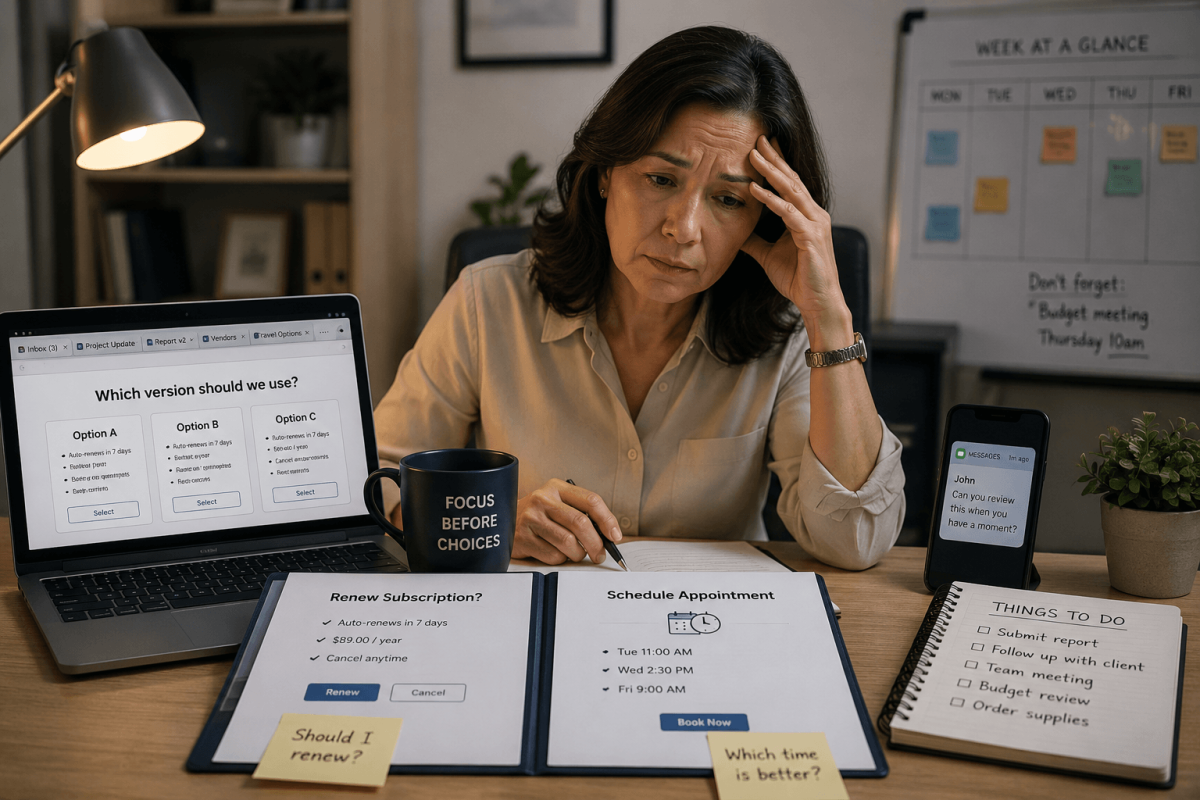
You are not facing a life-changing decision.
You are deciding which email to answer first.
What to make for dinner.
Whether to schedule the appointment today or deal with it tomorrow.
Which of three nearly identical options to buy.
Yet instead of making the choice and moving on, you hesitate.
You compare.
You reopen the same tabs.
You ask someone else what they think.
Then, strangely, you feel tired before you have actually done anything.
This experience is often called decision fatigue—the feeling that making one more choice requires far more mental effort than it should.
It can leave capable, intelligent people wondering why they have become so indecisive.
But the problem may not be that you have lost your judgment.
Your brain may simply be trying to make decisions while carrying too much else at the same time.
What Is Decision Fatigue?
Decision fatigue describes the decline in mental clarity, patience, or consistency that can appear after prolonged thinking and repeated decision-making.
It is not a formal medical diagnosis. It is also more complicated than the popular idea that every choice removes a fixed amount of “willpower” from your brain.
Researchers increasingly describe decision fatigue as the result of several overlapping pressures, including cognitive load, emotional strain, time on task, poor recovery, stress, and the complexity of the decisions being made. Reviews of decision fatigue have also noted that the concept is measured inconsistently, which means it should not be treated as one simple biological switch that turns off after too many choices. Research examining decision fatigue continues to develop.
The everyday experience, however, is familiar.
After spending hours answering questions, comparing options, solving problems, and reacting to interruptions, you may notice that you:
- postpone simple choices
- choose the easiest option rather than the best one
- become unusually irritated when someone asks another question
- repeatedly reconsider decisions you have already made
- avoid beginning tasks that require planning
- default to scrolling, snacking, or checking messages
- ask other people to decide for you
This does not necessarily mean your decision-making ability is disappearing.
It may mean the mental systems supporting good decisions are already occupied.
Every Decision Uses More Than Judgment
A decision is rarely just a choice between A and B.
To choose well, your brain may need to:
- remember what you are trying to accomplish
- hold several options in working memory
- compare the advantages and disadvantages
- ignore irrelevant information
- predict possible outcomes
- manage your emotional reaction
- commit without continuing to second-guess yourself
That is a considerable amount of cognitive work.
Working memory is especially important because it allows you to temporarily hold and manipulate information while solving a problem. It supports planning, reasoning, reading comprehension, and decision-making.
If working memory is overloaded, you may also notice that information does not seem to stick. You might finish a paragraph only to realize you cannot remember what you just read. If that sounds familiar, read our guide on why you forget what you just read.
But working memory is limited.
When it is already holding an unfinished conversation, tomorrow’s schedule, three work problems, a financial concern, and the reminder that someone is waiting for your reply, a small additional decision may feel disproportionately difficult.
The choice is not necessarily hard.
The mental workspace required to make it is already crowded.
Why Small Choices Can Feel Harder Than Big Ones
Large decisions usually announce themselves.
You know they matter, so you create time for them. You gather information. You speak with someone you trust. You expect the process to require effort.
Small decisions arrive without warning.
They appear between other tasks:
“Can you approve this?”
“What time works for you?”
“Which version should we use?”
“Do you want to renew this?”
“Should we order it now?”
Each question may seem insignificant. But every one asks your brain to stop, load a new set of information, evaluate it, respond, and then reconstruct whatever you were thinking about before.
This is closely connected to the mental cost of task switching.
You are not only making the decision. You are repeatedly changing cognitive context.
That is why a day filled with small questions can feel more mentally exhausting than several hours spent on one meaningful project.
You may have completed dozens of things, yet still feel as though your mind never fully settled into any of them.
Related: Why You Keep Making Small Mistakes at Work
Cognitive Load Makes Decisions Feel Heavier
Cognitive load is the amount of information your brain is trying to process at one time.
Some of that load is visible:
- the document in front of you
- the numbers you are comparing
- the conversation you are having
- the instructions you are following
Some of it remains in the background:
- unfinished work
- unanswered messages
- concerns about family
- appointments you need to schedule
- things you are afraid of forgetting
- decisions you have postponed
For responsibilities you keep trying to remember, our guide to using external reminders shows how to give each task a clear action and a useful cue.
These open mental loops do not always occupy your full attention. But they can continue competing for access to it.
That means your brain may be trying to evaluate a new choice while simultaneously preventing several unrelated concerns from disappearing.
This is why decision fatigue often appears alongside mental clutter.
Related research on cognitive fatigue also shows how sustained mental effort can reduce cognitive performance over time.
You know the information.
You understand the choices.
But you cannot seem to create enough clean mental space to compare them calmly.
Related: Mental Clutter: Why Your Mind Feels Full but Not Focused
Stress Quietly Reduces Your Decision-Making Capacity
Stress does not have to feel dramatic to affect thinking.
You may not feel panicked. You may simply feel slightly rushed, watchful, impatient, or mentally preoccupied.
Part of your attention is then directed toward managing that state.
Research on stress and cognition suggests that stress can compete with working memory and attention, particularly when the cognitive demand of a task is already high. In other words, stress creates another stream of information your brain must manage while it is trying to think.
This helps explain why the same decision can feel easy one day and impossible the next.
The options did not change.
Your available cognitive capacity did.
When your mind is calm and relatively clear, you may evaluate the information and decide within minutes.
When you are carrying unresolved stress, you may read the same information repeatedly without feeling ready to commit.
Poor Sleep Changes How You Choose
Sleep affects more than whether you feel awake.
It also influences attention, cognitive flexibility, judgment, feedback processing, and the effort you are willing to invest in a decision.
A recent scoping review examining 25 studies and more than 2,200 participants found that sleep deprivation commonly impaired aspects of decision-making, although the strength and type of impairment varied across tasks and individuals. Some studies found greater risk-taking, while others found smaller or inconsistent effects. The review is available through PubMed.
That nuance matters.
Poor sleep does not automatically make every decision bad. But it can make effortful thinking more difficult and make simpler, faster, or more immediately rewarding choices more appealing.
Interestingly, some people notice the opposite effect later in the evening, when distractions are lower and their thoughts seem to flow more easily. If you’ve ever wondered why your mind feels clearer after dark, our article on why some people think better at night explains the science behind it.
This is why the late-night version of you may:
- buy something you would normally compare more carefully
- avoid an important conversation
- agree to something just to end the discussion
- abandon a task that felt manageable earlier
- decide that tomorrow’s problem belongs to tomorrow’s brain
Sometimes postponing a decision is wise.
But repeatedly postponing decisions because your brain cannot create enough clarity is different.
Is Decision Fatigue a Sign of Cognitive Decline?
Not necessarily.
Normal aging can bring mild changes in processing speed, attention, multitasking, and how quickly information is retrieved. At the same time, experience, knowledge, pattern recognition, and judgment can remain strong or even become more useful with age. How the aging brain affects thinking, according to the National Institute on Aging, includes mild slowing in processing speed and multitasking while many reasoning abilities remain intact.
Many people interpret any increase in mental effort as evidence that they are “losing it.”
But needing more time to process several competing variables is not the same as losing the ability to reason.
Often, the problem is environmental.
There are more messages.
More accounts.
More subscriptions.
More information.
More responsibilities.
More people asking for immediate answers.
The modern brain is expected to make a continuous stream of low-level decisions while remaining available for high-level thinking.
That is an unreasonable cognitive arrangement.
Related: Why Your Brain Feels Slower After 50
How to Reduce Decision Fatigue
The goal is not to eliminate decisions.
It is to stop spending valuable cognitive energy on choices that do not deserve it.
1. Create Defaults for Repetitive Decisions
Decide once wherever possible.
Create a default breakfast, workout time, grocery list, meeting structure, or weekly planning routine.
Defaults do not remove freedom. They preserve your mental resources for decisions where judgment genuinely matters.
2. Write the Variables Down
Do not force working memory to hold everything.
When comparing options, write down:
- the actual objective
- the three most important criteria
- the available choices
- the consequences that matter
- the deadline for deciding
Externalizing information reduces the number of variables your brain must continuously maintain.
3. Separate Decisions From Notifications
A decision made immediately after an interruption is often made from a fragmented mental state.
When possible, collect nonurgent decisions and address them during one or two designated windows.
This prevents your entire day from becoming a sequence of cognitive restarts.
4. Use a “Good Enough” Threshold
Not every decision deserves optimization.
Ask:
“Will the difference between these options still matter in six months?”
When the answer is no, choose an option that meets your essential requirements and move forward.
The cost of endlessly searching for the perfect answer may be greater than the difference between the available choices.
5. Make Important Decisions Earlier
Pay attention to when your mind is naturally clearest.
For many people, that is earlier in the day, before meetings, messages, and unresolved tasks accumulate.
Protect that window for decisions that require comparison, judgment, and long-term thinking.
6. Recover Before Adding More Stimulation
When your thinking becomes slow, the instinct is often to push harder or consume more caffeine.
Sometimes that works temporarily.
But mental fatigue is not always a stimulation problem.
A short walk, food, hydration, quiet, sleep, or ten minutes without new information may restore more clarity than another stream of input.
Clear Thinking Requires More Than Mental Energy
Many people describe decision fatigue as needing “more energy.”
But energy without clarity can simply make a scattered mind move faster.
Good decision-making requires several abilities working together:
- enough attention to identify what matters
- enough working memory to compare the options
- enough mental stamina to stay with the problem
- enough calm to avoid reacting impulsively
- enough clarity to commit and move forward
This distinction matters when considering cognitive support.
You do not merely want to feel activated.
You want your attention, memory, and mental energy to work together.
Where Lumultra Fits
The experience customers often describe is not a lack of intelligence.
They know what needs to be done.
They understand the options.
But accessing that knowledge feels less smooth than it once did.
Lumultra was formulated around that gap—the distance between having the ability to think clearly and being able to access that clarity consistently when the day becomes demanding.
Its formula is spearheaded by Noopept and combines focus, memory, and energy ingredients intended to support working memory, sustained attention, and overall cognitive performance. The formula also includes ingredients such as phosphatidylserine, acetyl-L-carnitine, L-tyrosine, Panax ginseng, and guarana.
Lumultra is not a substitute for sleep, recovery, or better decision systems.
It is designed to complement them.
Because once unnecessary decisions are removed and mental clutter is reduced, the next goal is helping your brain remain clear, engaged, and available for the decisions that still matter.
For especially demanding mornings or extended periods of mental and physical output, Nova can be paired with Lumultra as an optional energy and mood-support companion. Nova combines caffeine, L-theanine, and N-acetyl-L-tyrosine and should not be taken late in the day because its stimulating ingredients may interfere with sleep.
Explore Lumultra for clearer, more consistent thinking
Explore Lumultra + Nova for higher-demand days
You May Not Be Indecisive
You may be mentally overloaded.
There is an important difference.
Indecisiveness sounds like a personality flaw.
Cognitive overload is a condition you can change.
Reduce the number of low-value choices.
Move important thinking into your clearest hours.
Get information out of working memory and onto paper.
Protect your brain from constant context switching.
Support the mental systems that help you hold information, maintain focus, and follow a thought through to its conclusion.
The goal is not to make every decision instantly.
It is to stop allowing small decisions to consume the clarity you need for the important ones.
Frequently Asked Questions
What does decision fatigue feel like?
Decision fatigue can feel like hesitation, irritability, avoidance, repeated second-guessing, impulsive choices, or mental exhaustion after making numerous decisions. It may also make simple questions feel disproportionately demanding.
Why do I struggle to make decisions when I am tired?
Decision-making uses attention, working memory, cognitive flexibility, and judgment. When you are tired, stressed, or sleep deprived, those processes may require more effort, making the easiest or most immediate option more appealing.
How can I recover from decision fatigue quickly?
Step away from new information, write down the variables you are considering, eat or hydrate if needed, take a short walk, and postpone nonurgent decisions until a clearer time. Longer-term improvements come from creating defaults, reducing interruptions, protecting sleep, and grouping low-priority decisions together.