
You are halfway through a sentence when it happens.
You know exactly what you want to say. You can picture the person, object, place, or idea clearly. You may even remember the first letter of the word.
But the word itself will not come.
Having words stuck on the tip of your tongue can feel surprisingly unsettling—especially when it happens with a name or expression you have used hundreds of times before.
For many people, the most disturbing part is not the awkward pause. It is the question that immediately follows:
Why can’t I remember something I know that I know?
The reassuring answer is that the information may not be gone. Your brain may simply be having difficulty reaching it quickly.
The Word May Still Be in Your Memory
A tip-of-the-tongue moment is different from having no memory of a word at all.
You usually retain part of the information. You know what the word means. You may remember what it sounds like, how many syllables it has, or another word that begins with the same letter.
This suggests that the knowledge itself is still present. The temporary failure occurs while your brain is attempting to retrieve the word’s complete spoken form.
Researchers describe tip-of-the-tongue experiences as temporary word-finding failures in which someone cannot produce a familiar word despite feeling certain that they know it. These experiences become more common with normal aging, even when broader language knowledge remains strong.
In other words, the memory may still be stored. The path leading to it has become slower or less reliable.
Remembering a Word Is Not One Simple Action
We tend to think of memory as a mental storage cabinet.
Either the information is inside, or it is not.
But retrieving a word requires several processes to work together rapidly.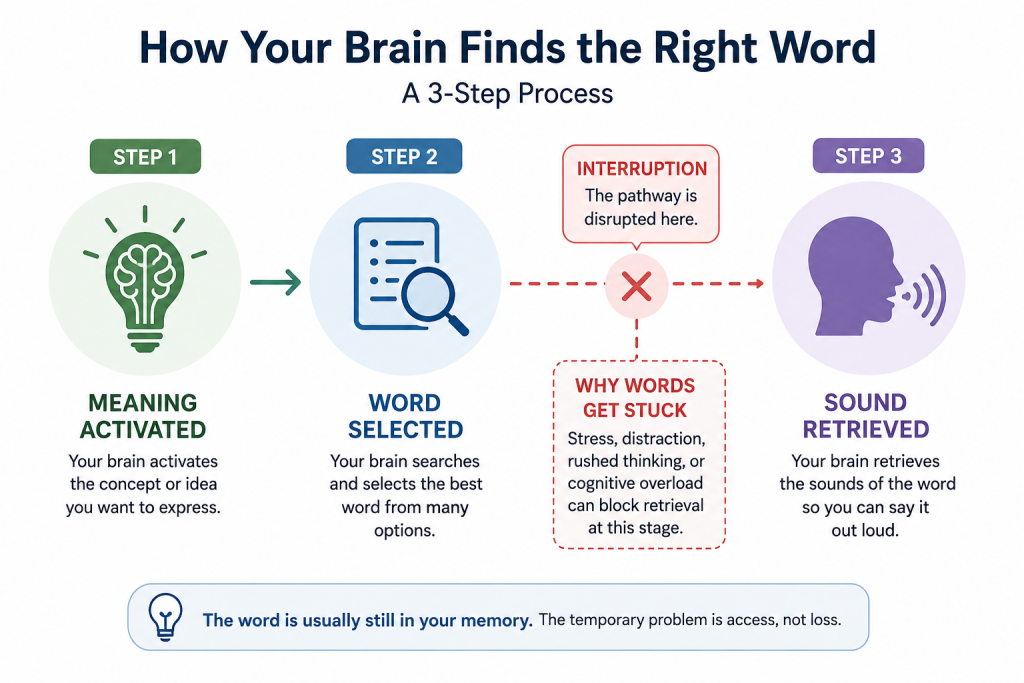
First, your brain activates the meaning or concept. Then it identifies the appropriate word among related possibilities. Finally, it retrieves the sounds needed to pronounce that word.
A disruption can occur during any part of that process.
You might know you are thinking of an actor but be unable to retrieve his name. You may remember that a word means “being able to recover quickly,” yet still be unable to produce the word “resilient.”
That is why you can often describe the missing word without being able to say it:
- “It is the tool you use to tighten that.”
- “She was in that movie with…”
- “It means something like adaptable.”
- “It starts with an R.”
Your brain has reached the concept. It just has not completed the final step.
Why It May Happen More Often as You Get Older
Word-finding pauses can happen at any age. However, many adults notice that they occur more frequently in their 40s, 50s, and beyond. This is one reason many people also begin having more difficulty remembering names, even though they still recognize the people they know.
Research on aging and language production suggests that older adults often retain extensive vocabulary and general knowledge while becoming slower at retrieving the exact sounds of familiar words.
This creates a frustrating contradiction:
You may know more than you did when you were younger, yet occasionally need longer to access what you know.
Your brain has accumulated decades of names, experiences, facts, professional language, places, products, and relationships. But accessing one precise word from that enormous network can require more cognitive control than it once did.
The word has not necessarily disappeared. Retrieval has simply become less immediate.
Word Retrieval Also Depends on Attention
Finding the right word is not a language-only task.
Your brain must hold the meaning of your sentence in working memory, ignore competing words, search long-term memory, select the correct expression, and continue following the conversation.
Research involving adults between ages 55 and 84 found that aspects of executive function—including mental shifting and verbal fluency—were associated with naming speed and accuracy. This suggests that successful word retrieval partly depends on broader cognitive control, not only vocabulary.
That helps explain why word-finding problems may feel worse when:
- You are doing several things at once.
- Someone interrupts you.
- You feel rushed to respond.
- You are mentally preoccupied.
- You are trying to speak while reading or checking your phone.
- Your mind is already carrying too many unfinished thoughts.
Your brain is not merely looking for a word. It is trying to find that word while managing everything else demanding your attention.
Why Forcing the Word Can Make the Moment Worse
When a familiar word disappears, most people respond by pushing harder. Similar brain blanks under pressure can happen during conversations, presentations, or stressful situations when anxiety competes for your attention.
Pressure can affect more than word retrieval; it can also explain why your mind goes blank under pressure even when you know exactly what you want to say
You mentally repeat the idea. You search through similar words. You become increasingly aware that someone is waiting for you to finish speaking.
The pressure quickly becomes part of the problem.
Instead of using your cognitive resources to retrieve the word, you begin using them to monitor yourself:
- Why can’t I remember this?
- Do I sound confused?
- Is this happening more often?
- What will the other person think?
- Is something wrong with my memory?
The missing word becomes emotionally charged.
This is why the word often returns five minutes later—after the conversation has ended and you are no longer trying so hard.
The retrieval system is finally operating without the added burden of self-consciousness and urgency.
What to Do When the Word Will Not Come
You cannot guarantee that every word will appear instantly, but you can make retrieval easier.
Pause Instead of Panicking
Give your brain a few seconds.
A brief pause may feel much longer to you than it does to the person listening. Trying to fill every second with nervous speech can create even more interference.
Describe the Meaning
Use a synonym or describe the object, person, or idea.
This keeps the conversation moving and may activate related information that helps your brain reach the missing word.
Think About the Sound
Ask yourself:
- What letter might it begin with?
- How many syllables does it have?
- Does it rhyme with another word?
- Can I remember how it sounds in a familiar sentence?
Research has found that sound-based cues can sometimes help resolve tip-of-the-tongue states in both younger and older adults.
Stop Searching Temporarily
Move on and allow the word to return naturally.
This is not surrender. It is reducing the mental competition that may be blocking retrieval.
Build Better Conditions for Recall
Most people focus on memory only at the moment it fails.
But recall depends heavily on the condition your brain is in before you need the information.
A brain that is overloaded, constantly interrupted, or mentally depleted has fewer resources available for precise retrieval.
Supporting recall therefore means supporting the broader cognitive environment around it.
That includes:
- Giving conversations your full attention.
- Reducing unnecessary task switching.
- Taking short mental breaks before important discussions.
- Protecting sleep and recovery.
- Using names and new words actively instead of only recognizing them.
- Maintaining a consistent routine that supports focus and cognitive readiness.
The goal is not to force your brain to work harder. It is to reduce the friction between what you know and your ability to access it.
Where Lumultra Fits
When people notice slower recall, their first instinct is often to look for something that creates more stimulation.
But greater stimulation is not always the same as clearer thinking.
Word retrieval depends on attention stability, working memory, mental continuity, and efficient access to stored information. When those systems feel strained, simply adding more intensity may leave you feeling alert but still mentally scattered.
Lumultra is formulated as daily nootropic support for focus, memory recall, mental clarity, and cognitive performance.
The objective is not to overpower your brain. It is to support the conditions that allow your thinking to feel more connected and accessible—so the information you already know is easier to use when you need it.
For particularly demanding days when low mental energy is also part of the problem, Nova can complement Lumultra with additional support for drive and sustained performance.
But for recurring moments when you know the information is there and simply cannot reach it quickly, Lumultra is the more direct place to begin.
When Word-Finding Problems Deserve Medical Attention
Occasionally forgetting a word can be part of normal age-related forgetfulness, although persistent or worsening symptoms deserve evaluation. The National Institute on Aging specifically distinguishes sometimes forgetting which word to use from more serious difficulties that interfere with conversation or everyday functioning.
Speak with a qualified healthcare professional when word-finding problems:
- Appear suddenly.
- Become noticeably more frequent.
- Interfere with ordinary conversations.
- Involve common, familiar objects repeatedly.
- Occur alongside confusion, personality changes, weakness, severe headaches, or other new symptoms.
- Make it difficult to perform tasks you previously handled easily.
A supplement should never be used to ignore a sudden or progressive cognitive change.
The Word Is Often Still There
A tip-of-the-tongue moment feels like memory loss because you cannot produce the information on demand.
But frequently, the word has not disappeared.
Your brain has retained the meaning. It recognizes that the correct word exists. It may even retrieve fragments of its sound.
The temporary problem is access.
And access is influenced by much more than memory alone. It depends on attention, mental energy, cognitive control, pressure, and the overall condition in which your brain is being asked to perform.
The next time a word disappears, pause before assuming the worst.
Your brain may not be empty.
It may simply need a clearer path to what it already knows.