
If you’ve ever wondered how long it takes to refocus after interruption —
or why it always feels longer than it should —
this is probably why your day feels slower than it should.
You sit down to work.
Nothing complicated.
Nothing you haven’t done before.
But for a few seconds…
you feel slower than you should.
Like you forgot how to do something you’ve done a hundred times…
and for a second, something feels off…
like your brain lagged for a second
like you suddenly don’t trust your own thinking
You start… then pause.
Your cursor moves…
then stops halfway
because something feels off
even though you don’t know what.
Then you reread.
and it still doesn’t click the first time
And suddenly, you hesitate longer than you should.
So you check something first.
Slack.
Your inbox.
A notification.
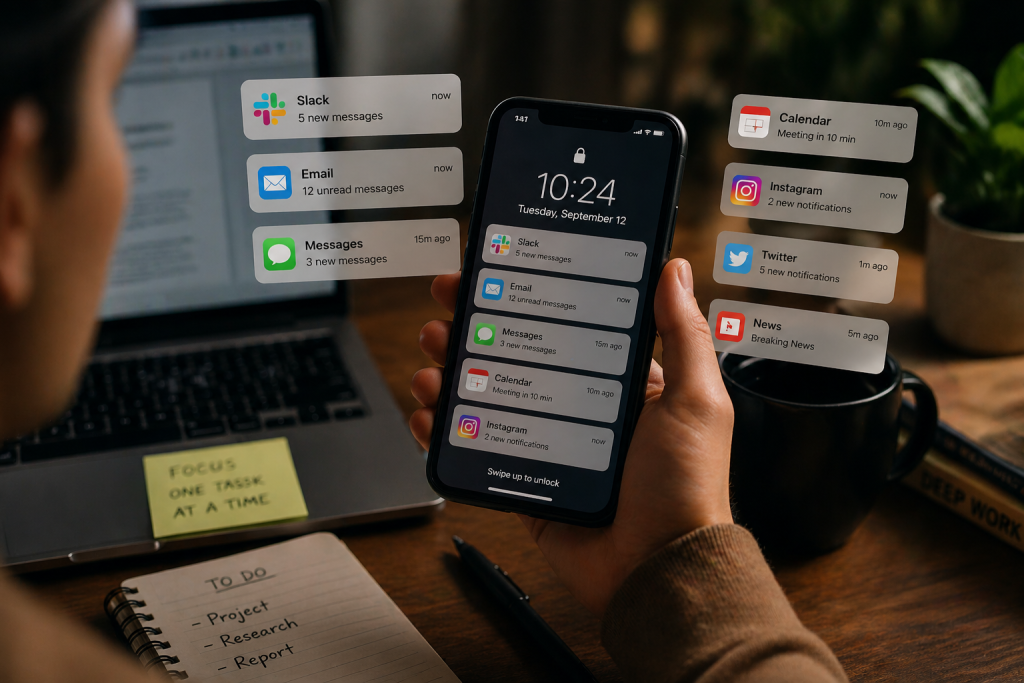
Then you come back.
But now it feels like you’re easing into something
that should’ve been easy to continue.
You’re not continuing your work —
you’re becoming a beginner again…
but with the pressure of someone who’s supposed to already be good at this.
What’s actually happening (and why it feels off)
What’s actually happening is easy to miss.
You’re not picking up where you left off.
You’re rebuilding it — from scratch.
The version of you that knew exactly what to do?
It’s gone.
That means reconstructing:
- what you were doing
- where you were in it
- what mattered in that moment
That takes time.
Not seconds.
Minutes.
And if you get pulled away again before it fully locks in—
you reset again.
This is the part nobody says out loud:
it’s not just frustrating —
it makes you question your own sharpness.
like you’re slower than you used to be — even if you’re not
Why does it feel so hard to focus again after being interrupted?
Because your brain doesn’t pause tasks.
It deletes the active version of them.
And when you come back—
you’re not resuming…
That’s why this keeps happening:
you reread the same line… again
not because it’s hard — but because it doesn’t register
you pause mid-thought
and for a second… your mind goes blank
you remember the task…
but not the next step
so you sit there longer than you should
you were about to do something
and now you’re just staring
trying to remember what that was
Not because you lack discipline.
Because nothing had time to fully stick.
The part nobody tells you about interruptions
Interruptions don’t just slow you down in the moment.
This is also one reason interruptions can leave you reading the same sentence over and over: you’re rebuilding the mental context needed to understand it.
They train your brain to stop trusting momentum.
So even when nothing interrupts you…
you still hesitate.
You still feel that slight delay
before getting into anything.
That’s why your day feels slow
even when you’re “not that distracted.”
Why interruptions ruin focus more than you think (it’s not what you expect)
The reason why interruptions ruin focus isn’t just the distraction itself —
it’s the reset that happens after.
The interruption itself isn’t the real problem.
It’s what it breaks.
You open a task…
check Slack “for a second”…
reply quickly…
then come back…
…and now you’re staring at your screen longer than you should.
Trying to reload:
- what you were doing
- what your next step was
- how everything connected
That’s where the time goes.
Not in the interruption—
but in the recovery.
You’re not slow.
You’re just constantly becoming a beginner again.
Not because you’re bad at focusing —
but because you never stay the same version of yourself long enough to get good at it.
This is why you can be busy all day…
and still feel like you barely got anything done.
The hidden cost of task switching on productivity
Most people think task switching costs seconds.
But it doesn’t.
It costs mental continuity.
You’re writing something.
Then you switch tabs to look something up.
You open one page… then another… then another.
A few seconds pass.
Then you stop.
And you realize you don’t remember why you opened any of them.
so you click around for a bit…
hoping it comes back
until you eventually give up
and switch tasks again
so your day fills up with started things… but barely anything actually finished
Now you go back.
And instead of writing—
you sit there, trying to reconstruct your train of thought.
This is the real cost of task switching on productivity — not lost time, but lost mental state.
So how long does it take to refocus after an interruption in real life?
Task switching doesn’t just slow your work.
It deletes the version of you
that knew exactly what to do next.
This hidden cost of task switching on productivity is why your day feels slower even when you’re constantly busy.
How long does it take to refocus after interruption
In most cases, how long does it take to refocus after an interruption isn’t just a few seconds —
it can take several minutes to fully rebuild your mental state, based on studies on how long it takes to refocus after an interruption.
Because refocusing isn’t one step.
It’s a sequence.
First, you reorient: what am I doing?
Then you reload context: where was I?
Then you rebuild momentum: okay… continue…
That process takes minutes — which is why how long it takes to get back into focus after distraction is almost always longer than people expect.
And if you get interrupted again before that process finishes—
you reset again.
Why your brain feels slower after switching tasks
It’s not one interruption.
It’s dozens of small ones.
Each one forces your brain to:
- drop context
- rebuild context
- regain momentum
So by the end of the day:
- things take longer than they should
- simple tasks feel heavier
- you never fully get into flow
Not because you’re tired.
But because you never stay in one version of yourself
long enough to build speed.
This may also explain why some people focus better at night, when the constant cycle of interruption and refocusing finally slows down
How to reduce the cost of interruptions (without forcing discipline)
Most advice tells you to eliminate distractions.
But that’s not always realistic.
Interruptions happen.
So the real question is:
how much do they cost you?
What matters is your brain’s ability to:
- hold context longer
- return to tasks faster
- rebuild focus with less effort
So you don’t keep starting over.
Where Lumultra fits in
Most tools try to force focus.
Short bursts. Timers. Quick spikes.
Coffee doesn’t fix this.
It might wake you up —
but it doesn’t stop your focus from breaking.
Willpower doesn’t fix it either.
You can force yourself to sit there…
but you can’t force your brain to hold momentum.
But that’s not the real problem.
The real problem is this:
your focus doesn’t last long enough to build momentum.
That’s why everything feels like a restart.
Lumultra is built for something different.
Not getting you into focus—
but keeping you there.
So instead of constantly dropping out
and having to rebuild your mental state…
you stay in it longer.
Long enough for things to click.
Long enough to build speed.
Long enough for work to feel smooth again.
So when interruptions happen—
they don’t hit as hard.
Because you’re not operating on fragile focus anymore.
You’re operating on sustained momentum.
You’re not trying to get into focus over and over again.
You’re staying in it.
Final thought
If your day feels slower than it should—
it’s not your effort.
It’s the constant restarting.
Imagine going through your work…
without that feeling.
No “what was I doing?”
No slow ramp-up.
No hesitation.
Just… continuity.
The kind where you forget what it felt like
to constantly start over.
If you’re tired of constantly starting over —
this is where you fix it.
Lumultra is where you stop starting over.