It’s Not Laziness. It’s Something Much More Interesting.
If you’ve ever wondered why your focus crashes halfway through the day, you’re not alone.
You start the day sharp.
Your inbox gets cleared.
You solve problems quickly.
You remember details effortlessly.
For a few hours, your mind feels like a precision instrument.
Then something changes.
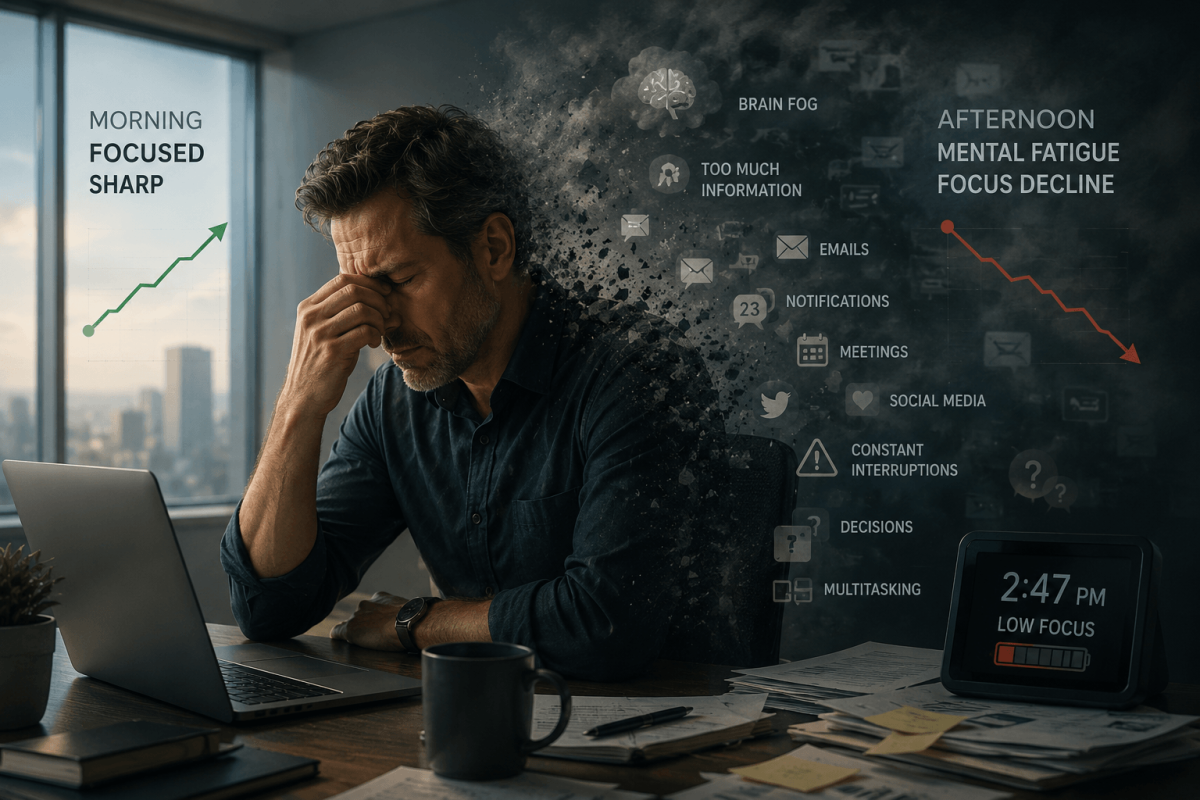
By early afternoon, you’re reading the same paragraph three times. Tasks that seemed simple in the morning suddenly feel heavier. You open a browser tab and forget why you opened it. Conversations become harder to track. Your attention begins drifting toward distractions.
And perhaps most frustrating of all—you know you’re capable of better.
Many people assume this is simply part of getting older.
But that’s not entirely true.
What’s actually happening is far more complex—and understanding it may explain why so many intelligent, high-performing people feel mentally exhausted long before the day is over.
Why Your Focus Crashes Halfway Through the Day in a World of Constant Input
Most people think focus is something you either have or don’t have.
In reality, focus is a resource.
And like every resource, it can be depleted.
Understanding why your focus crashes halfway through the day starts with understanding how cognitive overload accumulates.
The modern brain is processing more information in a single day than previous generations encountered in weeks.
Emails.
Notifications.
News.
Text messages.
Meetings.
Social media.
Podcasts.
Videos.
Browser tabs.
Constant decisions.
Your brain isn’t simply working.
It’s continuously filtering.
Every notification ignored.
Every email postponed.
Every decision made.
Every interruption resisted.
All of it consumes mental energy.
By noon, many people aren’t suffering from a lack of intelligence or motivation.
They’re experiencing cognitive overload.
The mental equivalent of having too many applications running at once.
Why Your Focus Crashes Halfway Through the Day When Your Attention Keeps Switching
One of the biggest myths about productivity is multitasking.
Research from Stanford University has shown that chronic multitaskers tend to perform worse on attention-related tasks than those who focus on one task at a time.
Neuroscientists have repeatedly shown that the brain doesn’t truly multitask.
It switches.
Rapidly.
Constantly.
And every switch carries a cost.
Imagine driving from Los Angeles to San Francisco—but every ten miles someone forces you to turn around and drive back for a few minutes before continuing.
Eventually you’ll reach your destination.
But you’ll burn far more fuel getting there.
Your brain works similarly.
Every time you jump between tasks, emails, messages, meetings, and notifications, your attention system spends energy rebuilding context.
Most people don’t realize they’re mentally exhausted because of the work itself.
They’re exhausted from repeatedly restarting their thinking.
Why Brain Fog Appears When Your Focus Crashes Halfway Through the Day
If you keep rereading the same sentence without absorbing it, your working memory may be struggling to hold the information long enough for the idea to fully register.
Brain fog isn’t a medical diagnosis.
It’s a description.
A feeling.
A sense that your thoughts have become less accessible.
Names take longer to recall.
Words sit just outside your reach.
You know what you want to say—but your brain seems slower retrieving it.
One reason this often appears later in the day involves working memory.
Working memory functions like your brain’s temporary workspace.
It’s where information is held and manipulated while you’re thinking, planning, solving problems, or making decisions.
Throughout the day, this system becomes increasingly burdened.
The more unfinished tasks, unresolved decisions, and incoming information you accumulate, the harder working memory must work.
Eventually the system becomes congested.
The result feels like mental friction.
Not because your brain has become weaker.
But because it’s carrying too much.
That afternoon slowdown can feel like brain fog, mental fatigue, or both—although the two experiences are not exactly the same.
The Dopamine Trap Behind Why Your Focus Crashes Halfway Through the Day
Here’s something even more interesting.
Many focus problems aren’t caused by insufficient stimulation.
They’re caused by excessive stimulation.
Another reason your focus crashes halfway through the day may have less to do with energy and more to do with how modern technology trains attention.
Every notification.
Every social media refresh.
Every breaking news alert.
Every quick burst of novelty.
Triggers dopamine activity.
Dopamine isn’t simply a “pleasure chemical.”
It’s heavily involved in motivation, attention, and the pursuit of new information.
The problem emerges when the brain becomes accustomed to constant novelty.
Deep work begins feeling less rewarding.
Reading feels harder.
Concentration feels slower.
Tasks requiring sustained attention start competing against a brain that’s been conditioned to expect frequent stimulation.
This is one reason many people report:
- Shorter attention spans
- More distraction
- Increased procrastination
- Difficulty staying engaged with complex work
- Mental restlessness
The issue isn’t necessarily that focus has disappeared.
It’s that the brain has become accustomed to faster rewards.
The Real Problem Isn’t Energy—It’s Mental Endurance
Most people think focus and energy are the same thing.
They’re not.
You can have plenty of physical energy and still struggle to think clearly.
Mental endurance is different.
It’s the ability to sustain high-quality thinking over extended periods.
This is where many professionals begin noticing subtle changes as they move through their 40s, 50s, and beyond.
Not dramatic cognitive decline.
Nothing severe.
Just a growing sense that their mental stamina isn’t what it used to be.
The challenge isn’t solving one difficult problem.
The challenge is solving the tenth difficult problem of the day with the same clarity as the first.
And that’s where many people begin feeling frustrated.
Because experience has made them smarter.
Yet sustaining focus seems harder.
If your thinking suddenly becomes clearer once the day gets quiet, there may also be a reason your brain works better at night even after struggling with focus all afternoon.
The Insight Most People Miss
Here’s a perspective that often changes how people think about mental performance:
Your brain is not failing because it can’t handle complexity.
It’s struggling because it’s handling too much complexity without enough recovery.
There’s a difference.
Many high performers assume the solution is to push harder.
Work longer.
Consume more information.
Stay connected.
Remain productive.
But cognitive performance doesn’t improve through endless stimulation.
It improves through strategic recovery.
The brain needs periods where information can be processed rather than merely consumed.
Without those periods, even highly capable minds begin operating below their potential.
Why This Matters More As You Get Older
One advantage of age is accumulated knowledge.
Pattern recognition improves.
Judgment improves.
Wisdom improves.
The challenge is maintaining access to those strengths under modern cognitive demands.
When mental fatigue accumulates, many people mistakenly assume they’re becoming less capable.
Mental fatigue can make low-reward tasks feel disproportionately difficult, even when you still have enough attention for something more interesting.
Late-day mental fatigue can make it harder to retain what you read, even when the material itself is not difficult.
In reality, they may simply be experiencing the effects of digital overload, attention fragmentation, and sustained cognitive stress.
The goal isn’t trying to think like your 25-year-old self.
The goal is preserving access to the experience, insight, and mental sharpness you’ve spent decades building.
Because those are your real competitive advantages.
The Bottom Line
If your focus crashes halfway through the day, don’t immediately assume something is wrong with you.
Once you understand why your focus crashes halfway through the day, the solution becomes much less about working harder and much more about protecting your cognitive resources.
The modern world places extraordinary demands on attention.
Most people are carrying far more cognitive load than they realize.
Mental fatigue, brain fog, distraction, and declining focus often aren’t signs of laziness or lack of discipline.
They’re signals.
Signals that your brain’s resources are being stretched beyond what they’re designed to handle continuously.
The people who stay mentally sharp longest aren’t necessarily the ones who work the hardest.
They’re often the ones who learn how to protect their attention.
Because in a world competing for every second of your focus, attention isn’t just a productivity tool.
It’s one of your most valuable cognitive assets.
At Lumultra, we believe mental performance isn’t about chasing superhuman productivity. It’s about preserving clarity, focus, and cognitive resilience so you can continue operating at your best—today, and for years to come.